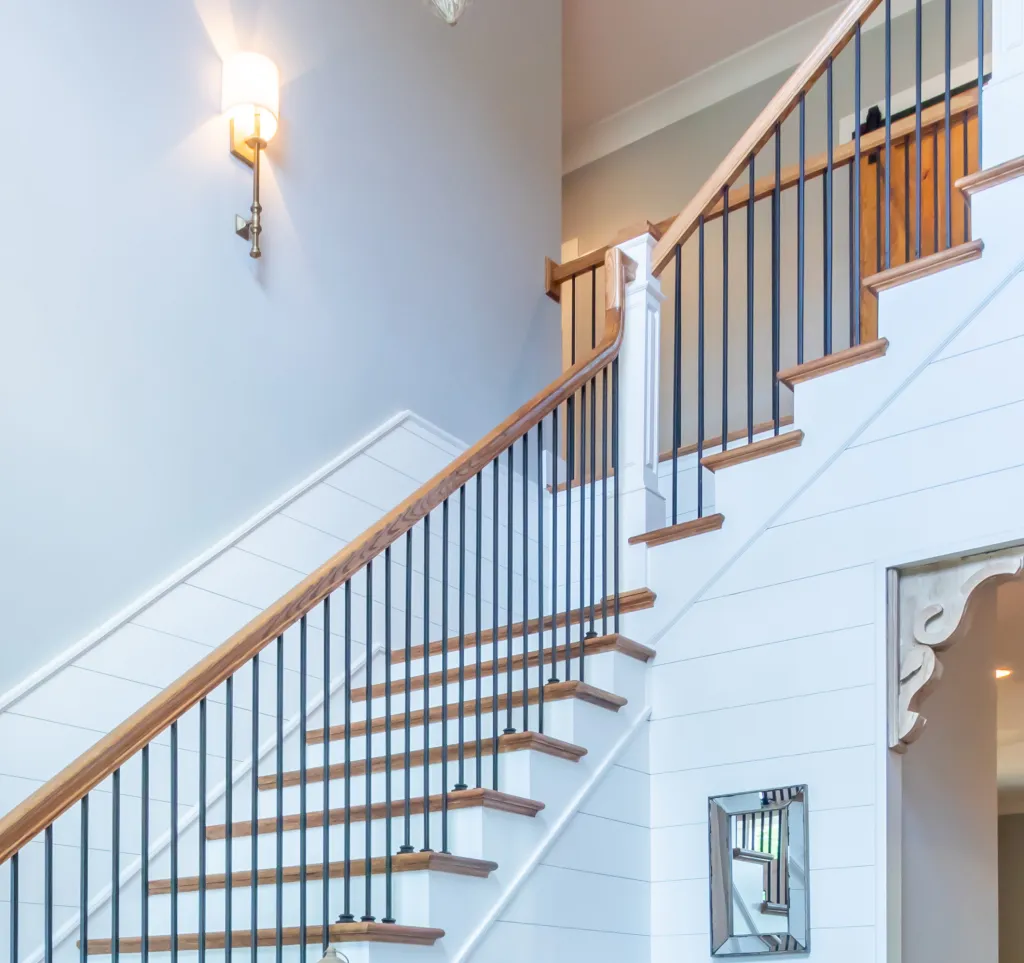
Journal of Light Construction: I’m about to embark on an exciting build of a “dancing winder” staircase this summer, which I’ll document in a JLC article to come later this year. Before we get to that complex winding stair, however, I thought I’d begin easing into the topic of winding stairs with a discussion of the simplest design—a basic “quarter-turn,” or L-shaped, stairway with two half-flights of stairs, a lower one leading up to a landing, where it turns the corner and starts the upper half-flight.


2 comments:
I love the concept of a pie shaped landing. Although it is probably more costly than the more common square landing it both physically connects that handrail and visually causes your eyes to connect the two sections of stair. Adding small details such as a thought out landing brings the architecture of a building to the next level. I also found it so silly that the majority of stair falls happen due to the landing because humans will consistently take the shortest path. Landings seem like they should be required to unstack the risers to maintain a consistent tread depth the entire way up the staircase. By maintaining a consistent tread depth less falls would probably occur on the landings of a staircase and prevent harm. Overall the construction of stairs in general is so unique to the space and I wish there were better visually thought out stairs even if they might cost slightly more than basic squares.
I think the more you know about carpentry, the better you can fully understand the true art form that is woodwork. So, when I see a blog post by The Journal of Light Construction about something I know little about, it draws me to it. I’ve never built or planned out a “quarter-turn” or L-shaped staircase, so seeing the background of what went into designing it. With it showing the challenge of stacked risers at the inside corner. The layout commonly used actually complicates the handrail design, forcing builders to use a multi-piece gooseneck transition that is not a pretty look in a new house, something I would have to deal with if I built staircases. However, when Campbell brought up elongating the landing by a single tread and unstacking the risers, it allowed for a continuous, great handrail design. It helped teach me how planning and geometry elevate the function of this craftsmanship.
Post a Comment