Community, Leadership, Experimentation, Diversity, & Education
Pittsburgh Arts, Regional Theatre, New Work, Producing, Copyright, Labor Unions,
New Products, Coping Skills, J-O-Bs...
Theatre industry news, University & School of Drama Announcements, plus occasional course support for
Carnegie Mellon School of Drama Faculty, Staff, Students, and Alumni.
CMU School of Drama
Showing posts with label Scenic Art. Show all posts
Wednesday, February 25, 2026
Setting the stage
It’s Your Yale: The unkempt, boozy Berenger and the handsome well-heeled Dudard sit in a peaceful café in a small French town. Suddenly, a thunderous, ear-splitting noise rents the air, and a massive rhinoceros rampages through the square, trampling everything in its path and leaving a dust storm in its wake. All quietude is lost as the two men and townspeople gather to analyze and debate the horned giant’s invasion.
Tuesday, February 02, 2021
Meet the Soil Scientists Using Dirt to Make Stunning Paints
Science | Smithsonian Magazine: In September, as wildfire raged in Medicine Bow National Forest, Karen Vaughan watched smoke billow in a choked-off Wyoming sky. The sun was reduced to a matte neon-pink disc behind the haze, and Vaughan worried about her research site in the burning mountains. One of her graduate students still had one more day of fieldwork to complete, and the roads would soon be closed, if they weren’t already.
Labels:
Art,
Art Supplies,
Painting,
Scenic Art
Thursday, November 05, 2020
Travels of a Scenic Artist and Scholar: Boott Mills Standard Sheeting for Stage Scenery at the Tabor Opera House in Leadville, Colorado.
Drypigment.net: While traveling across the country, I documented historic scenery at several venues, including the Tabor Opera House in Leadville, Colorado. We pulled into Leadville on June 18, having scheduled a quick stop at the Tabor Opera House, before heading to Twin Lakes and Independence Pass. The next day was my 49th birthday, and I decided to treat myself to a morning in the attic at the Tabor Opera House.
Monday, November 02, 2020
Travels of a Scenic Artist and Scholar – The Tabor Opera House, Leadville, Colorado. Painted Shutters by T. Frank Cox, 1888.
Drypigment.net: The Tabor Opera House in Leadville, Colorado, was renamed the Elks Opera House when the Benevolent and Protective Order of Elks (B.P.O.E.) purchased the building in 1901. Immediately after the purchase, the building was renovated. Part of the stage renovation included adding a fly loft, so that new scenery could be raised out of sight. Previously, the Tabor Opera House used wings, shutters, roll drops and borders.
Tuesday, October 27, 2020
Travels of a Scenic Artist and Scholar – The Richmond Scottish Rite, October 24-26, 2020
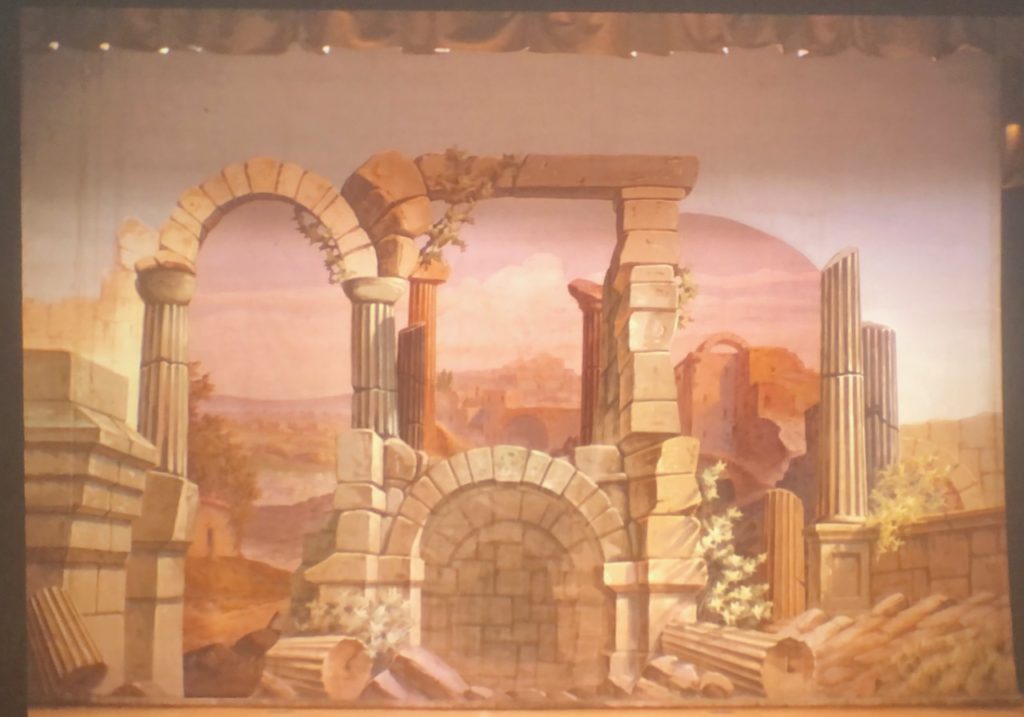
Drypigment.net: It has been a busy month, and I am currently in Richmond, Virginia. The Richmond Scottish Rite Theatre appeared on my radar again last month. The timing was less than ideal, since I was packing to leave for the Tabor Opera House in Leadville, Colorado. On September 17, I received word from Art DeHoyos that the Richmond Scottish Rite was selling their building and had no plans for the historic scenery collection.
Monday, September 28, 2020
Travels of a Scenic Artist and Scholar. Day 6 at The Tabor Opera House. September 26, 2020.
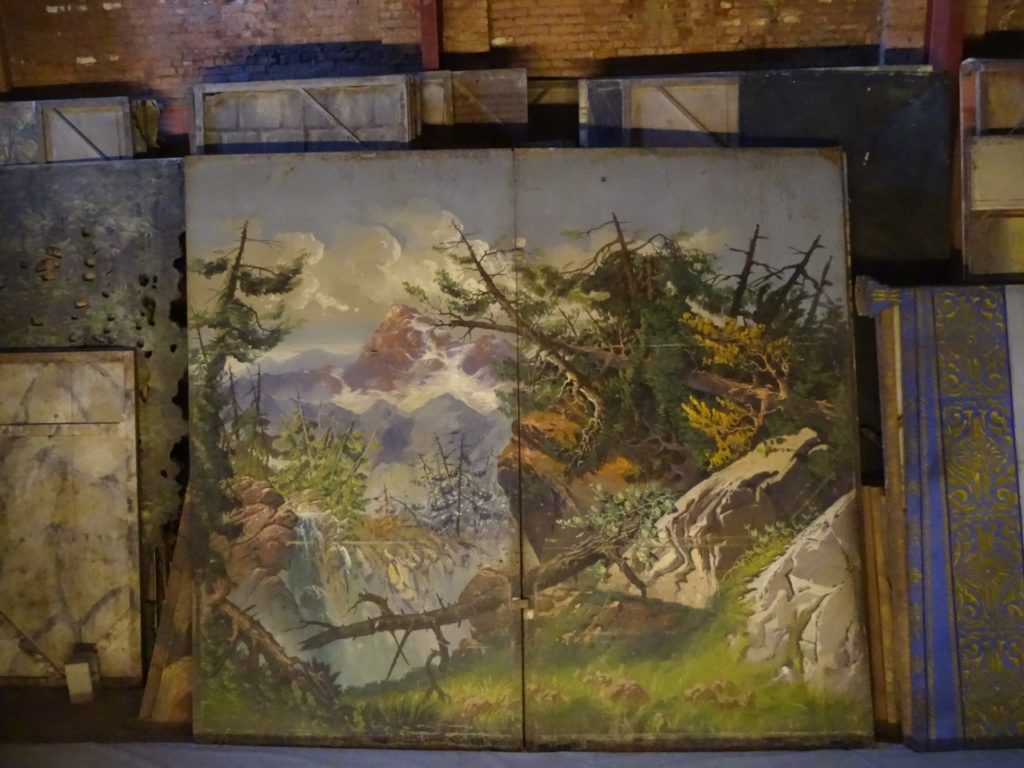
Drypigment.net: Saturday was our last big day to lower scenery from the attic at the Tabor Opera House in Leadville, Colorado. It was the sixth of seven workdays in a row. We did manage to hit our goal of lowering all remaining shutter scenes, plus a few other pieces, to the stage floor. The attic looks positively bare. Only eight borders remain for me to document today. That being said, some scenic pieces still remain in the loft above the attic and on platforms high above stage right and stage left.
Thursday, September 24, 2020
Travels of a Scenic Artist and Scholar. Day 2 at The Tabor Opera House. September 22, 2020.
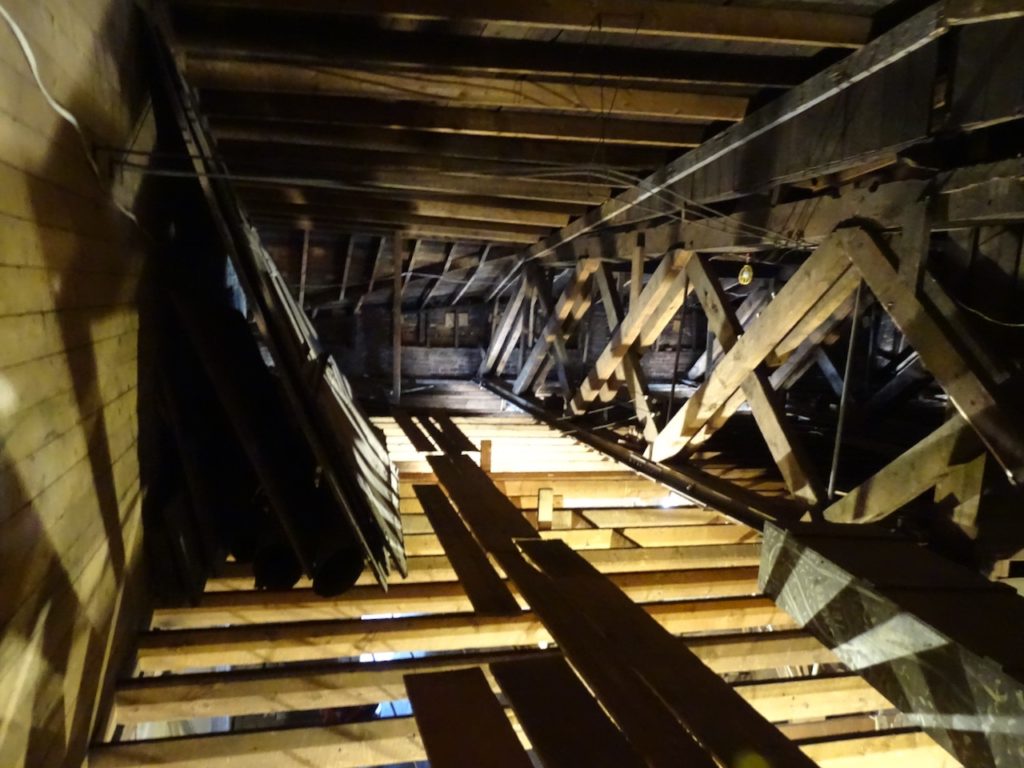
Drypigment.net: There is a variety of historic scenery tucked away in the attic at the Tabor Opera House in Leadville, Colorado. When the building was renovated, the stage was enlarged, and all of the original wings and shutters were carefully tucked away above the auditorium ceiling. This attic space was also once home to a few hotel rooms, divided by a central sky hall that allowed natural light for each room.
Wednesday, September 23, 2020
Travels of a Scenic Artist and Scholar. Day 1 at The Tabor Opera House. September 21, 2020.
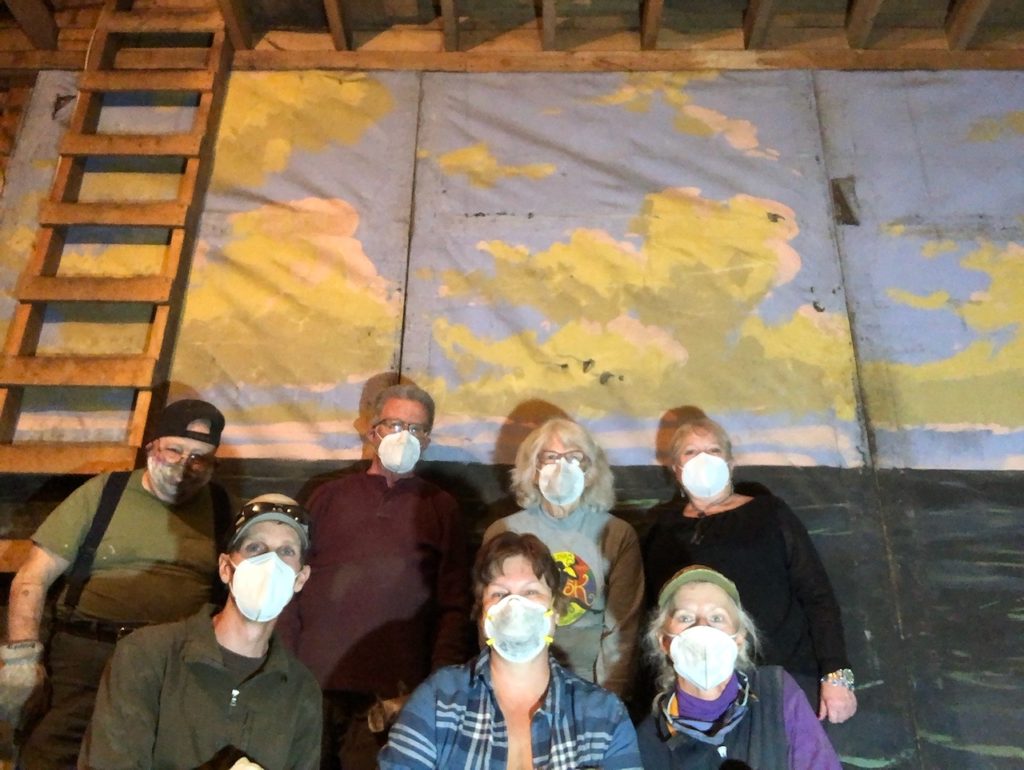
Drypigment.net: Today was my first day on site at the Tabor Opera House. I am in town to document the historic scenery collections in the attic; last spring I documented the scenery collections on the stage. This is such a very important collection, in both in the scope of American theatre history and world theatre history.
Thursday, September 03, 2020
Real Wood Grainers Have Curves
Guild of Scenic Artists: For our February show at Connecticut Repertory Theatre, Men on Boats, the design called for post-like wood columns and very textured “rough cut” wood planks. I assigned senior undergraduate student Mikayla Carr to be the Scenic Charge for this show. We wanted to use this opportunity to create homemade wood graining tools that we could use to create this texture on a curved surface. The planks were no issue as we used metal and rubber combs and grainers to drag through a thick coat of Jaxsan. But the rounded columns were a different challenge and we wanted something that could make the process go faster and be able to be carried through wider stretches of goop.
Saturday, July 04, 2020
Broadway’s Premier Backdrop Studio Is Nested in Newburgh
hvmag.com: If this year were any other, Broadway-lovers would be buzzing now about the recently announced winners of the 2020 Tony Awards (postponed from June 7 to an undetermined date) and trying to score tickets to see them. Alas, even the Great White Way — despite its “the show must go on” mantra — is no match for the current pandemic. As much as audiences are looking forward to getting back in their seats, behind-the-scenes businesses have an even more essential need for productions to resume.
Tuesday, October 15, 2019
Tales from a Scenic Artist and Scholar. Part 819 – Scenic Art Sundries, 1912 to Now

Drypigment.net: In 1912, Thomas G. Moses wrote, “June 1st, Sosman agreed to pay me what I wanted, $5,200.00 per year besides my dividends, which will make my income not less than $6,500.00 – not quite as good as the New York venture, but I will be satisfied.” $6500 in 1912 is equivalent in purchasing power to about $171,920.31 in 2019. Of that number, $137,526.25 was Moses’ salary without his dividends.
Monday, September 09, 2019
The Origin Story Of Earth Umber – The Overlooked Earth Tone You Should Be Using
Rosco Spectrum: Yes, Earth Umber is a color that a scenic artist could easily mix on their own, but for someone that typically works at small schools with limited assistance, I think this paint – which is only available from Rosco – offers enormous value.
Friday, February 08, 2019
Tales from a Scenic Artist and Scholar. Part 639 – Operating Means for Curtain Drops, Victor H. Volland in 1926
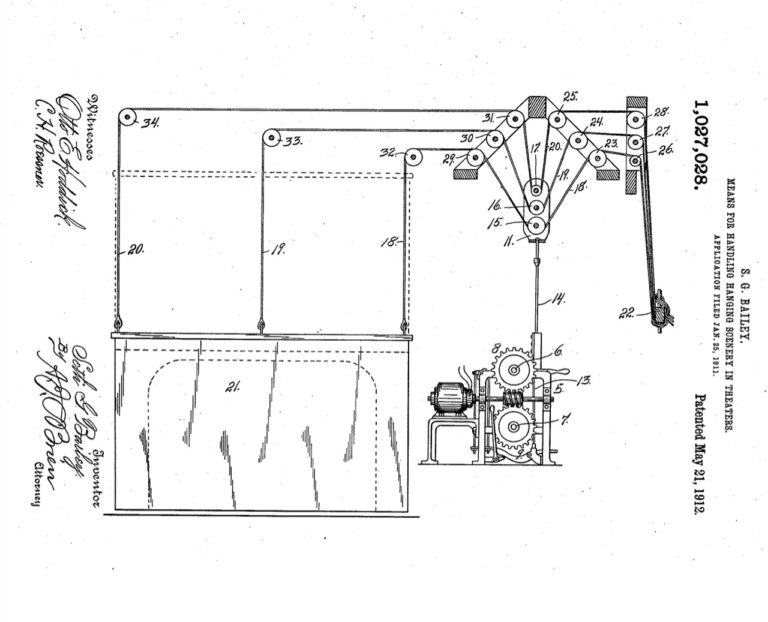
Drypigment.net: A little more than a decade after Seth G. Bailey invented an electrical mechanism for handling hanging scenery, Victor H. Volland came up with another option to handle scenery. In 1930, the United States Patent Office published an application filed on August 23, 1926 for operating curtain drops.
Thursday, February 07, 2019
Tales from a Scenic Artist and Scholar. Part 638 – Electrical Mechanism for Handling Hanging Scenery, 1910
Drypigment.net: Here is a mind blowing article that I stumbled across well over a year ago. It was published in the “Lincoln Star” on Dec. 18, 1910. Keep that date in mind – 1910. I came across the article while I was looking for information pertaining to David H. Hunt, the Sosman & Landis salesman who was a founder of New York Studios, a scenic firm) and Sosman, Landis, & Hunt, a theatrical management company. New York Studios was advertised as the eastern affiliate of the Sosman & Landis, similar to many regional offices established by scenic studios during this time.
Friday, November 02, 2018
Diversion Murals in Dementia Care Units Are Painted to Soothe Residents
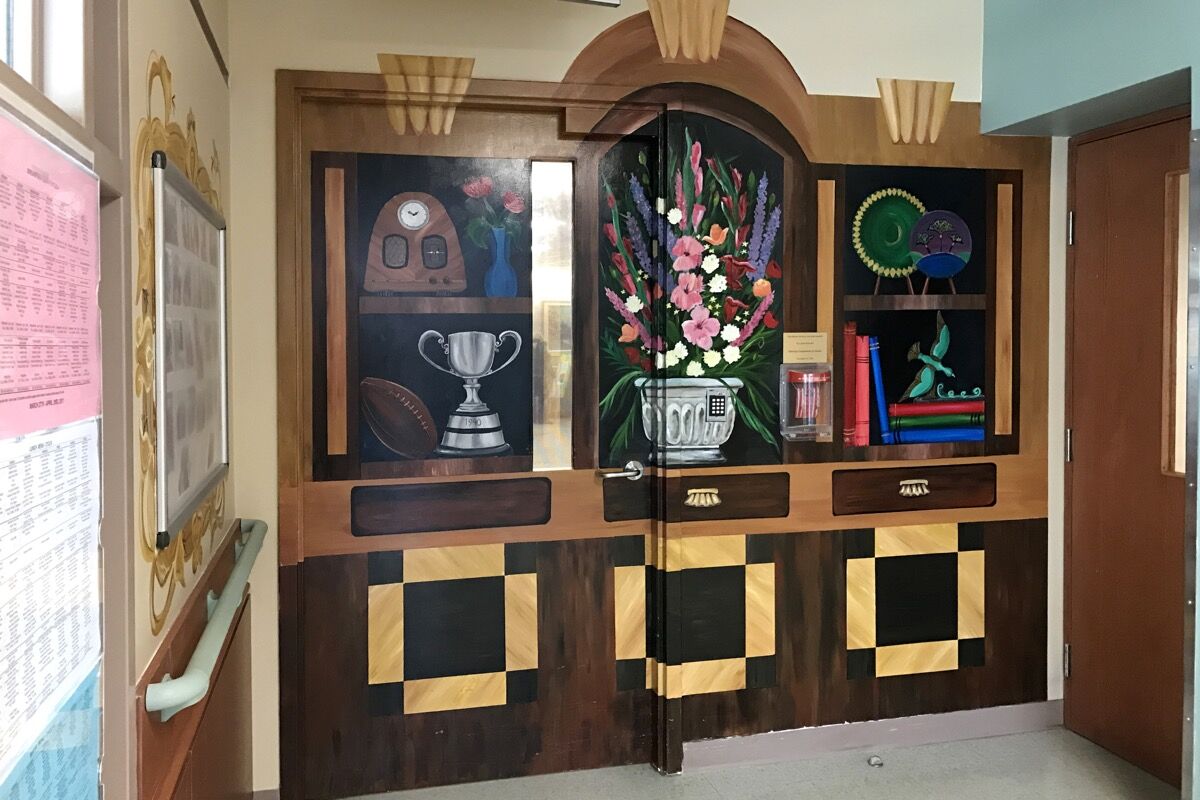
Artsy: In the hallways of a dementia care unit in Ottawa, Canada, artist Andréa Fabricius carefully paints over the exit doors with dynamic and unusual murals. They picture dark wood bureaus and armoires, decorated with books and flower pots and, in some cases, surrounded by patterned wallpaper—essentially, interior scenes that could have been plucked from a mid-century home. Known as diversion murals, they cleverly camouflage doors in order to quell the exit-seeking behavior of some people with dementia.
Subscribe to:
Posts (Atom)


