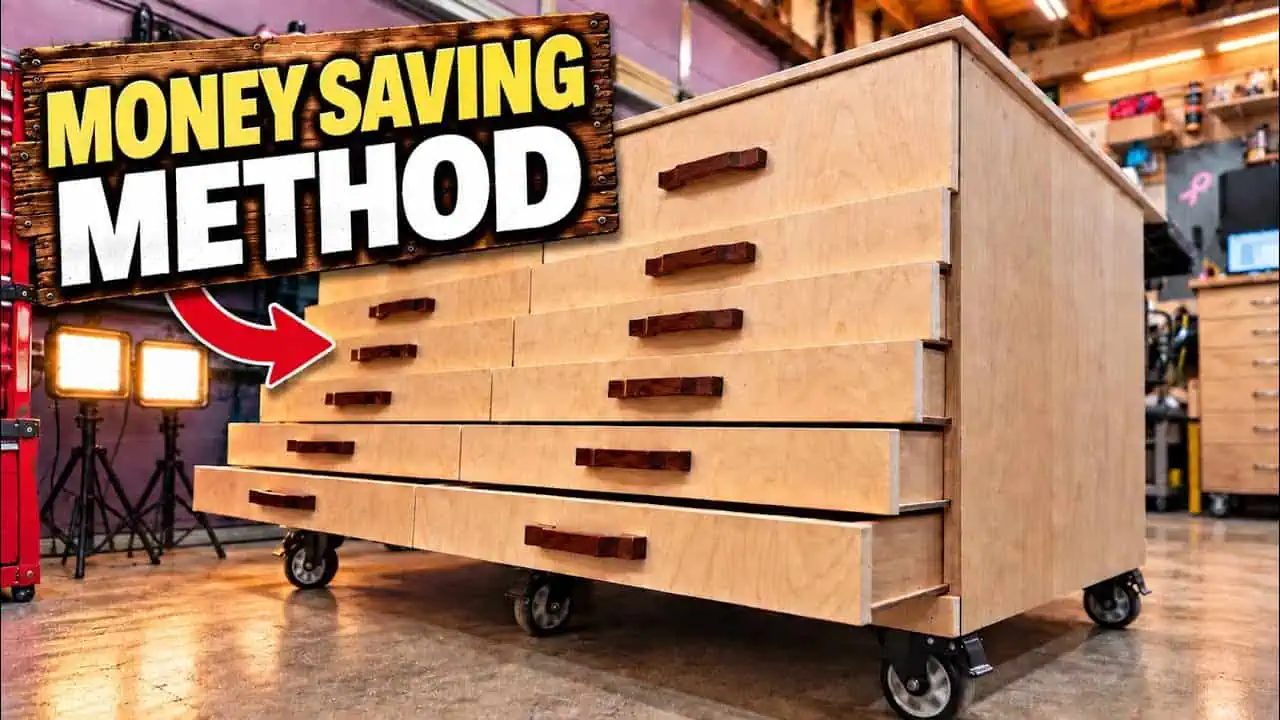
www.obsessedwoodworking.com: Chris set out to build a rolling workshop cabinet almost entirely from plywood, skipping traditional metal drawer slides altogether. The build started in his old shop in Jacksonville, Florida, and was finished up months later after a move to North Carolina, giving the video a bit of a two-part feel as the project traveled with him.


8 comments:
This is a really cool concept, I do not think I have heard of anything like this before. Building shelves can get very expensive when you start to have other buy specific hardware to create it. Although this guy used a CNC machine to cut out the plywood (which is not something most people just have on hand), I am sure there is a way to cut out the plywood similar to how a CNC machine would but with basic tools that everyone would have. If someone walked up to me a said Mai I need to make a drawer but all I have a plywood and I dont have all those bits you need to put it together I would send them this article and say fear not here is a comprehensive tutorial on how to make a drawer with not metal bits and only plywood and then we would clap and cheer.
I appreciated the response to the article at the bottom more than the actual article. The article itself didn’t explain a whole lot of the theory and things to keep in mind when constructing something like this, but the response at least offered some insight into the choices the original woodworker had made. When I first clicked on the article I thought that it was going to be a more in depth explanation of the process he used to make the drawer system. Granted, they did link the original video, but the article itself wasn’t quite what I was expecting it to be.
Discarding the use of metal slides because of their high production cost and limited usability is a valid point to start this personal project. I’ve had countless experiences where I want to pull the cabinet open more, or when they’re not made correctly, and the metal slides would just pop off, and it takes a whole hazard to put it back in on its rail. Reading through the creation process, I do wonder whether using glue as a substitute for the structural work would be the most effective, as I’m not sure about this, but I think the glue may wear off gradually over time. I found the attached video of the process of creation, and having the maker of the cabinet write the article himself adds authenticity and clarity to the project, as it gives a lot of personal insights into the detail of the process, invaluable to understanding the project. It is a pretty recent article, so I wonder how much the market and industry would be inspired by this idea and continue developing it, and wether the current building of cabinets would change from using metal slides to a complete wood-use of material?
Creating custom furniture sounds like a great idea for when I have my own place. Only you can make something that is utterly perfect for what you are using it for. One gripe I have with this project is actually the lack of metal hardware. As someone currently living with, and dealing with, a very finicky wooden dresser. It has no metal hardware and just one change in environment or a slight misalignment means that I have to fight the furniture piece in order to get to my clothes. An important part of making drawers is the ability for people other than the creator to use them. Drawers that don't have anything stopping them from easily being completely pulled out can often lead to things falling on the ground and that is never good. I think if I ever make a drawer unit I will most likely use metal hardware because I like having the ability to make something that will last instead of something that I would have to maintain every once in a while.
A Clever Plywood Drawer Cabinet With No Metal Slides:
I've never built a cabinet or a drawer before. Skipping the metal hardware is a big deal for saving money, and I can see why it appeals to Chris, since drawer slides can make up most of the hardware cost of a shop cabinet, so replacing them is where the biggest savings would come from. But the design relies on grooves cut into the cabinet with a CNC machine, and I think that kind of destroys a lot of those savings. Unless you already own a CNC, paying for one or for the cutting would likely cancel out what you'd save on slides.
What I'm most skeptical about is how it holds up over time. Wood furniture in homes is extremely common, but it faces a lot less stress and use than shop gear. A shop cabinet is opened constantly, loaded with heavy tools like a belt sander and hand planer, and rolled around on casters. I worry the wood runners, and other parts of the cabinet, will wear down faster and eventually break. The article's own commentary says waxing the runners helps and that antique dressers used wood runners long before metal slides existed, which is fair. But a dresser isn't carrying power tools in a dusty shop, or opening and closing a hundred times a day. This constant stress and use is a big reason why metal slides are preferred. If the runners do wear out, I wonder how easy they'd be to replace compared with swapping a metal slide, especially when the grooves are cut into the cabinet itself. Chris's cabinet is a clever idea, but I'd want to see how it looks after a few years of real use before using it myself.
I appreciate the way that this article has summed up the video that it is about. It seemed to have stuck with just the facts of laying out how the creator did things. As someone who does not always have the patience for long youtube videos, I liked how this was not a transcript of the video but a very in depth summary. Which also shows how the creator made the video to lay out the creation of the piece and go step by step. It is not just a “how to” but also a “here is why,” something that I appreciate because I learn more when I learn the why behind the thing instead of just “it just is.” There were a lot of little tips and tricks in the article that were helpful. I am going to go through and watch certain points of the video, especially the part where he lays out the drawer faces to match wood grain.
I think bringing attention to cost-saving practices like these is incredibly useful in today’s economy. When a smaller shop can bulk purchase plywood to create drawers instead of buying separate pieces, this can help them keep their costs down. However, there can be the trade-off of friction and warping from the elements. When using metal attachments, these are less present, but this can be fixed through experimentation on the rails in different situations and using wax on the wood. I wish the main article could have discussed the historical use and creation of this kind of woodworking because while metal rails are almost a given in our current lives, there was a time when there was no mass-produced metal. I think this would be a really interesting project to do to learn more about carpentry and the limits and abilities of wood. I wonder how creating this with saws instead of CNC routers would work and how accessible this project is.
I have never had to build a cabinet before so I am not very familiar with what has to go into it. However I do know that the tracks inside of it are important for keeping the drawer aligned and being able to come in and out smoothly. I wanted to read this article because new ways of building things might have a good application in some scenario that will come up in theatre. I think this is also a good demonstration of problem solving and innovation. The article mentions that drawer hardware is super expensive and buying it can drastically increase the price of a unit. Buy making it on a CNC they saved a lot of money and added some flexibility with the process and design as a whole. I would love to learn more ways that you can creatively make furniture and units without increasing the materials cost of anything. This would be a great way to cut down on budget while still keeping the same designs and pieces that the show wants.
Post a Comment