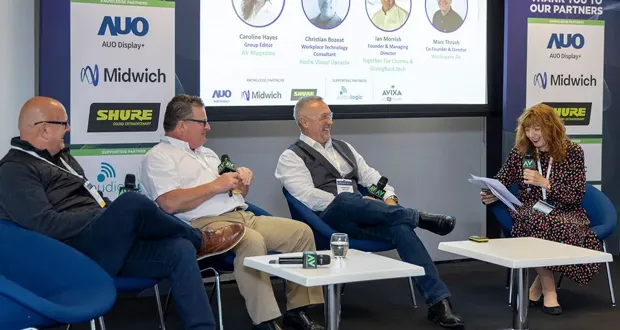
AV Magazine: Marjolein Koens-Schaddelee presented the keynote Designing AV for a Net Zero Future. The MD of AVEX made an analogy between sustainable practices and owning your first home; they both involve a sense of freedom with responsibility. She made the point that the AV industry needs to adopt a system approach rather than focus on individual behaviours and told summit attendees that it’s OK to fail, and that we can pick ourselves up and try something else.


4 comments:
Sustainability in the business scene is a tricky, but understandably necessary step that the business sphere needs to take. This article states it pretty clearly that being sustainable is a necessary step for businesses to protect the Earth. The issue for most companies is price specifically the price of creating sustainable practices. It is an unfortunate truth that sustainable business practices tend to be more expensive than non-sustainable business practices. This then makes it so that new start up companies or businesses have a harder time getting a foothold if they want to be sustainable. This can be especially true for a business model like theater productions or live entertainment where we regularly work with wood materials that are easily not sustainable in the long term. Then there is the question of how to measure sustainable practices and how to quantify levels of sustainability between businesses and fields, and that is something that can be tricky to figure out as a universal model.
I think this is a great topic to bring into the AV and more of the entertainment world. While we will always have consumables and things that we can’t really change how they might operate, its vastly important that we can make things as sustainable as possible where we can. I’m reminded of when I worked for the NFL draft striking the stage and event areas. So much of the scenery and pieces were immediately trashed. I understand a lot of the logistics of storing and reusing that kind of stuff but it also made me feel very wasteful chucking huge amounts of wood and steel straight into the trash. I think there could be a great way to make this more eco friendly. Of course this means for everyone more resources in other areas, either money or time or labor. What’s important is that people start developing ways to make this transition easier and that we can start treating environmentalism as a requirement rather than a thought.
I think we as educational theatre makers we have a cirtical responsihbilty in taking action around this topic becuase we have so much control over the future of theatre and design, by setting standards for ourself we can greatly increase the reusability of our scenery esepcially. While some things like gaff tape or spike tape's qualities make them invalueable and their usage as consumables is soemthing that prodcution straf should limit but it is understandably a difficult issue to fix, however in terms of scenery and costumes especially I believe that so much of or materials can be re-used with consideration for designers, maybe limiting one show a year to the leftover set peices and mateirals could be something to prove this. Currently our system will need to change, too much of theatre is focuesd on the temporary joy and immerision we cannot afford to be left behind in sustainabkity becuae of this vision and idea of traditon.
This is a MASSIVELY important conversation to be having. Not only have the trends in consumerism been showing that people are generating more and more waste from packaging and disposable products, with the trend of technology becoming equally disposable and the rate at which products become obsolete, and as it stands, e-recycling is an expensive and daunting task to undertake. It’s difficult enough to design and produce technology, it is even harder to take thousands of differing proprietary hardware and figure out how it can be uniformly recycled or repurposed beyond simply wiping it and reselling it as second-hand. The infrastructure alone for a single organization to have the means of being able to process all of various kinds of e-waste generated is likely a multi-billion dollar venture. I think conversations of sustainability significantly impact the theatre industry not only on the scenic side, as sustainable construction practices are complicated by the constant need for one-off creations and prototyping. Unfortunately, seeing shows strictly made from stock platforms and flats wouldn’t be nearly as rewarding as some of the shows we are able to put together. I see this as being critical in the newer areas within our industry, lighting, sound, and media. Think about how many new lighting instruments were released in the last year. And how many different fresnels, conventional ellipsoidals and PARs since their hay-day are now nearly obsolete. The shift towards LED fixtures is great for lowering energy consumption on a carbon-based electrical grid, however the rate at which our industry churns out new products and is constantly innovating is staggering. While as exciting as that is, we also have to be aware of what happens to the products downstream of us.
Post a Comment