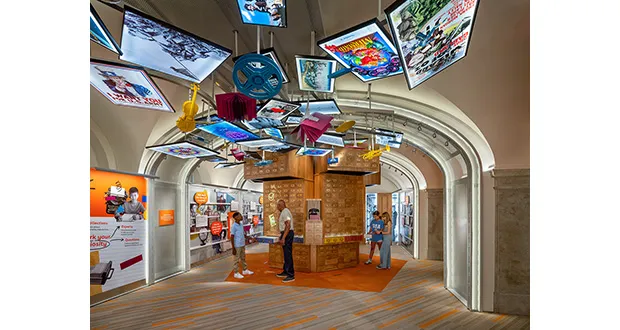
AV Magazine: The Library of Congress has opened The Source, an experiential research gallery where interactive AV technology helps children explore primary sources independently.
Part of the A Library for You initiative, the 370 sq metre space uses projection-mapped animation, RFID-enabled objects and digital workstations to introduce visitors aged eight to 15 to the library’s vast collections in film, text, sound and image.


9 comments:
I loved this article! I thought the project’s approach, combining actual research techniques with high-tech displays, interactivity, and virtual representations of actual artifacts was really interesting! I think it’s really important to get kids interested in learning when they’re young, and the colorful, fun, museum-esq style of The Source is a great way to do that. It also teaches them actual research skills, allowing them to find what they need on their own timeline, providing support while also letting them grow at their own rate. I think it’s fantastic that this was done by the Library of Congress, since they have such an extensive collection of sources and research materials; it’s the perfect place to give kids access to in order to ensure that they’ll have anything they need for their projects. As a whole, I really liked this article, and I think that The Source will be a great addition to the Library For You initiative.
There's a lot to like in this Library of Congress venture, but I have some minor qualms with it from a design perspective. Ever since someone pointed out that a lot of modern theme park attractions are built around screens or projections rather than physical decorations because digital decor 1. cost less and 2. is less of a hassle to retheme when whatever property the ride/show is based on stops being popular, any sort of screen-based attraction has had this inescapable pall over it. I don't know -- I like the physical world! I like things you can touch, things in 3D space, things with texture. When I began to read this article and was met with a lot of screen-based attractions, I felt myself deflate a bit. Of course, there are plenty of beautiful, interactive, and (as Kevin Hines would put it) meat-world research tools on display (the microfilm display being a personal favorite), but I still feel a little torn on some of the choices made. Despite that, getting kids into research and sifting through databases is a very admirable goal, no matter how you slice it.
When I was in the english program in my undergrad, I did a lot of discussing the purpose of libraries for research in our developing world, so I found this article interesting. I think this gallery will not only give children a constructive love for the library, but also a deep understanding of the importance of primary sources – seeking people out to talk about their experiences. When I express my interest in artistic research, I find that a lot of times people don’t know what I’m talking about because they think of it as discovery and scientific experimentation. This would be a great way to spark an interest in research early so that one doesn’t feel that there are boundaries for using libraries if they aren’t interested in STEM.
I assume a lot of people’s attitudes toward projects like this one is either “Wow what a great idea!”, or “Why aren’t all libraries doing this.” I wish more people would acknowledge that the idea that libraries should be developed as technology develops is a very popular idea, the funds to do so are just hard to come by.
This is something that I find very interesting. I’ve never seen an interactive library like this before, especially targeted towards kids. When I was growing up the focus was science museums where you could go in and physically touch these smaller versions of scientific discoveries. The library discussed in this article I think will be very helpful to kids who like to be more hands on and like using technology in their learning. The library is also focusing on 8 to 15 year olds so I assume there is a wide array of content for all students. The whole concept behind the library is that everyone is a researcher and throughout your time there the things you look up join a collage on the wall. I am personally not that familiar with AV and it’s set-up but I think this is a very cool learning experience for kids who want to combine technology and research.
As a kid, going to the Museum of Science was one of my favorite things because of how interactive all the exhibits are. I enjoy going to all kinds of museums, but especially ones that have interactive exhibits because I learn more with hands-on activities and when I can play around with information. I also have always wanted to work on creating an interactive exhibit because I feel like that would be a very fun way to use the skills that I have learned. It does also seem like this is a free resource which is wonderful. I wonder how long it took for this project to come to fruition because it seems like it would be at least a two year process, probably more. I just know that this exhibit will spark curiosity and, hopefully, a love for research in the kids that visit. I know that I would have loved this experience and am now thinking of convincing my aunt to bring my cousins (and me).
Knowledge is so important and a part of that is the availability and accessibility of the information and knowledge. A large old library can be intimidating and it seems like this is the perfect way to make learning into an interesting and fun process. As much as libraries are created for sharing knowledge and information, the knowledge of how to understand and use library systems has been drastically under taught. While online systems can be useful there are still primary resources that haven't been digitized. Particularly with the spreading of AI, physical media is seemingly becoming more and more important. You can know for sure that a book from before AI was created by human hands and not made up by a machine. We are living in what is known as the information age, but we need to do our due diligence to ensure that our knowledge can continue to be passed down and not be diluted with untruths.
What’s really awesome about this installation is that it allows for exploration and critical thinking from the user about what they are looking at and interacting with. I have started to see more and more digital interactions at libraries or museums. I think it is a fun way to teach kids about sources, history, science, and more. In a world with exploding tech and screens all around us, not adapting can mean people losing interest and not internalizing lessons and knowledge. By making this exhibit super interactive, it will allow kids to create connections and feel like they are a part of the process. I would love to know more about the actual electronics and systems that went into this project. Making something interactive and responsive means that you have to account for all the scenarios that could happen and make sure your system is fool proof when it comes to an end user operating it. I am especially interested in how physical drawers and objects can trigger projections and different reactions. I would love to spend time with the company Hyperquake and learn a bit about their process for installations such as this.
I think this a really great idea for educating children on the process of research, children will go through collecting data and resources for so many projects as they go though school(especially high school and college) I think it’s important to familiarize these concepts at an early age so that they can better understand them as they grow. I think an exhibit is a fun way to do this, i think that children can learn really well in interactive environments, it stimulates your brain a lot more than just looking at text on a sheet of paper and probably stay in their memory a lot longer too. Trips to exhibits like these create a lot of lasting memories and give kids the ability the explore concepts they haven’t before all the while providing important information about a topic they are probably about to cover in their classes soon(it gives real world application). I wish there were more exhibits like this for other topics as well in other subjects.
This exhibition sounds incredible and like such an awesome opportunity to allow kids to connect with research, learning, and curiosity. People always talk about how they worry about “the kids” who have grown up with computers and technology, but in my opinion that worry has more to do with the adults engineering products for the children than the kids themselves. Kids are always going to be curious if they are given the space to explore, and an interactive experience like The Source is a great place for kids to explore and learn. The other thing I find interesting about this exhibition is that it is using technology to make research and primary sources come alive for kids. When we think about libraries, primary sources, and critical thinking skills, technology often becomes an enemy, but this exhibit uses technology to help kids become interested in research. The way AI is contributing to a lack of critical thinking skills is a problem, but this exhibit shows that there are ways to use tech to our advantage and to help kids discover how to learn and research.
Post a Comment