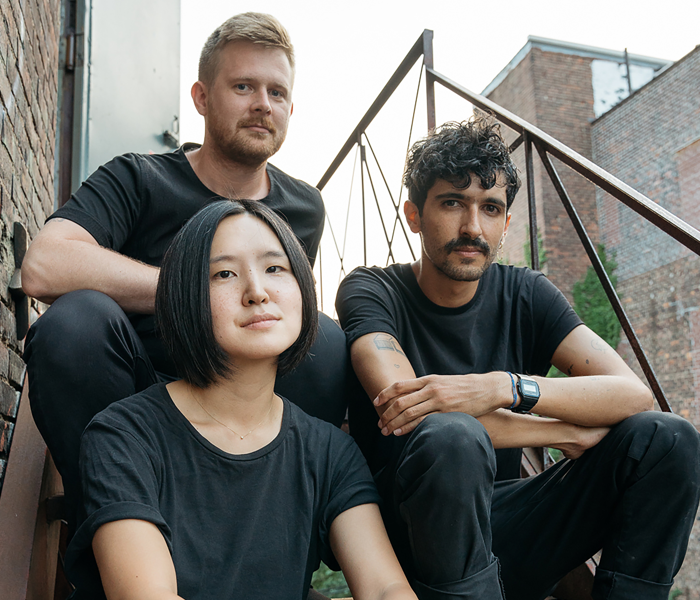
TDF: When the pandemic disrupted life, especially in the theatre, three set designers embarked on a remarkable collaboration that jump-started their careers post-shutdown. In 2020, Andrew Moerdyk, Kimie Nishikawa and Santiago Orjuela-Laverde, immigrants from South Africa, Japan and Colombia respectively, formed the NYC-based collective dots. The lowercase moniker, as per Moerdyk, signifies “how many individual dots/points/pixels come together to form a single beautiful image.”


8 comments:
I'm obviously familiar with the fabulous work of Dots, and I'm very glad to finally be able to put a group of faces to their work (which is the entire purpose of this website -- this is theatre manifest!). What I appreciate most about them and their method is the emphasis placed on communication. The group lacks a leader, even individual projects are not the baby of any individual member, and if there's a roadblock the members talk it out. Like adults. Groundbreaking! As I grow and develop as a theatrical artist at CMU, I'll try to take a page out of Dots' book by prioritizing quality of output rather than squabbling over how it gets done.
The article highlights the trios most popular work, but their website is a really good read (scroll?). They have a quite varied catalogue (another good piece of advice for the budding designer -- don't specialize too early). I quite like their design for a production of "tick, tick... Boom!"
I think there's something really important about collaborating with other people who have had the same training and in the same practice as you. Those types of conversations leave a lot of room for creativity and imagination as 3 different designers collaborate on one show. Coming from different backgrounds, perspectives, and personalities all competing in the same industry it's really interesting to see how they lay their dynamic out as a working team. It's really inspiring to see that type of collaboration where all 3 designers respect each other and when 1 person feels a stronger passion or love for a project they get the opportunity to take the lead and chase there creativity. Although Covid-19 was such a devastating time this trio took the crisis and turned shaped a new business out of it where they have successfully designed many Tony nominee sets. It really shows how strong of a community theatre is and how it connects us.
In an industry that is defined by collaboration I have always been surprised how individualized secluded certain designers can become in their field. I think the solution that – have come up with is ingenious and operates in such a way that the tree designers can do more and have people to lean on and support them as they work in this crazy industry. When working as three people you have the ability to take on a plethora of different projects allowing everyone involved to build their knowledge while still ensuring every show is properly supported. I feel like this system operates very similarly to the current layout of Carnegie Scenic. Having larger amounts of people work on the show as it is in its early stages such as budgeting and detailing before handing the production off to individual people as the production reaches build and load in. By having multiple people on the show at one time it ensures everyone can experience and learn from each individual production's requirements.
To be honest, I had never really heard of dots before - actually, I had no idea that stage design collectives even existed as a concept. However, after reading the article, I really like the idea of them; the inherent advantage to having more people/minds/ideas on a project was really striking to me, as well as the way they still value passion and artistic expression through their designs. I really appreciated learning about how they worked together, starting as a large group and eventually, letting somebody naturally come to the front of the project and take point. I also had no idea that they were the minds behind shows like Rocky Horror Picture Show, but I also think it was really interesting how, possibly because they are such a coherent, diverse group, they were also able to do designs for much more serious shows like Appropriate. As a whole, I really appreciated getting the chance to learn more about their design process, as well as about how design collectives function in general.
Of course, the whole idea of a collaborative group of designers is amazing, and something I really want to see more of in theater---instead of having one head designer and then associate designers working under them, having multiple designers who are all equal, and don't have to worry about impressing their boss with their work, instead focusing on the quality of their designs and creativity. What I like the most of this concept though is the ability to bounce ideas and designs off of one another, a thing you can't do as freely with the director or other designers. Multiple people together will always come up with cooler and better ideas, as well as provide the reassurance that you sometimes need, then just working on one's own. Overall, I would be interested to see this expanded to other designs fields such as lighting or costumes.
I think that designer collectives are such a fantastic idea and it truly is shocking that they are not more common. Like Santiago Orjuela-Laverde references in the interview, if architectural firms can do it, why can't designers? It is truly refreshing to see a group of enormously talented people lifting up each other's ideas and collaborating to produce one final project. In an industry that is so cutthroat and relatively hard to break into if you don't know the right people, to know that there are designers whose goal is not to be the best of everyone ever is great, because we've all met someone who acts like that. I also really appreciate their approach to deciding who does what. If there is a deeper emotional connection that one of the designers has to a show, they will take the lead on it. If someone's schedule works better for it, they will do the most work. It is all logical, smart decision-making that is an attitude that I think the rest of the theater industry would do well with adopting.
Collaboration can be an important part of working in theater and the more people working together the more a project can feel like the work of a community and not just one or a few people. I think that one of the things that has made this collaborative group so successful is their ability to communicate in a shared vocabulary. When collaborators are able to effectively express their ideas and values within a project with each other it can benefit the projects they take on in many ways. I wonder how these designers view their design aesthetics as individuals and as a group overall. No matter what the challenge is, no one person is going to approach it the same way as any other person and this can mean that the work of a group can help to view a problem and its solution more fully, but it can also mean that each individual artist may have times where they feel that their own vision isn’t able to come across when pushed into a set that is the product of their and multiple other’s work. While ego may not be helpful within a group setting it is almost impossible to negate any egotistical viewpoints as ego is a very common experience one experiences as a human on this planet.
I think this is a really cool thing for people to have done. Collaboration is always a key element of theatre or film. You already have to work with lots of other people to make a production happen. By working together on the same goal you have that many more people completing the work and inputting ideas to make it all go smoother. While you might have to come to some compromises, there are 3 times as many ideas as doing it alone and will allow you to explore even more perspectives. I think one thing that really helped in dots success is that they had the same training and background. Having the same starting point and approach to the process can streamline a lot of the first stages of design. I would really like to see what they are going to do in the future and how their collaboration shows itself on stage and through their different works.
Post a Comment