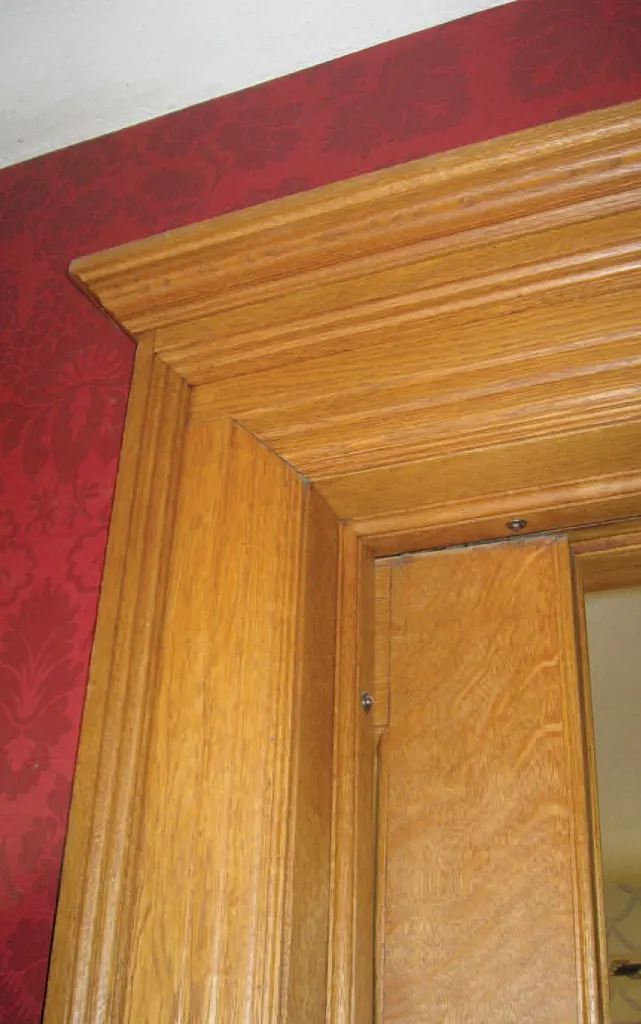
www.jlconline.com: One of the things I like about working on a historic home is the challenge of matching new work to old. Last summer, I was hired to do the finish work for a kitchen remodel in a 19th century Victorian home in Winona, Minn. The kitchen had been previously remodeled sometime in the 1960s in a contemporary style incompatible with the home’s period look.


4 comments:
Brian Campbell’s article on reproducing Victorian door casing is a great look at the connection of modern craftsmanship and keeping historical building techniques and looks preserved. When faced with a kitchen remodel in a 19th-century home, Brian Campbell chose to recreate the original, built-up molding profiles in-house rather than outsourcing the small project to get a truly personal touch to the project. He used yellow poplar and a table saw, and he meticulously replicated the three step design and even crafted a custom jig to make the tricky jack miter joints. I find this admirable. It's great to avoid the easy route and to truly honor the home’s original design and its own character that it has developed. It's also great to remember that high-quality work doesn't require industrial equipment, just patience and ingenuity. It's also great for the modern builder who wants to respect the past while delivering a high-quality finished product that stands with the rest of the time period house.
It’s always nice to see someone restoring some cool victorian style moulding instead of just modernizing everything. The fact that people managed to make these crazy intricate designs without power tools is so cool to me! The author of this article mentioning that using a power saw actually added a step to this whole process makes me wonder if there are any other cool vintage techniques that could possibly be easier without modern technology. I like how this article really highlights how much effort and labour hours went into making a door casing, it really makes you appreciate the work, and all this historical people who probably spent their time in a very similar way making this style long ago. Theatre is an industry that probably has to copy historical styles more often than almost any other business, but its interesting to see someone try so hard to match an original style much like shop carpenters do while building scenery.
When working in shops, I was always daunted by the task of figuring out molding for doorframes. We always would just buy molding from Home Depot and settle for what we could find. This article quite nicely breaks down the steps of how to build this molding. As a scenic designer, it is nice to see that there are almost always ways to build the details that I want in a set. It was also cool to learn about how carpenters would make these detailed moldings without access to power tools. The skill that it must have taken to make everything so perfect is admirable. The article also used a lot of carpentry jargon, and I was pleased that I was able to understand most of it. There are still things that I didn't understand, but that is a sign to push myself to learn more about carpentry so that I can become a better builder and designer.
The amount of effort and artistry put into older styles of architecture and architectural details and the lack of artistry to the same details today with the plain modern mass produced moldings and other architecture is a telling sign of how our priorities in building and buying houses have shifted over time. Modern architecture focuses on speed and simplicity, while older practices focused on creating something that could be passed down from generation to generation. This isn’t only seen in houses, but also in the furniture within them. Material objects these days are made cheaply and in a way that encourages the consumer to replace them after a while instead of sturdy objects of the past that often still last to today. I think that the little details like molding among other aspects are one of the strongest factors inspiring my love of old homes. I would love to be able to save up enough money to buy my own old house and spend time and energy fixing it up to comply with my tastes.
Post a Comment