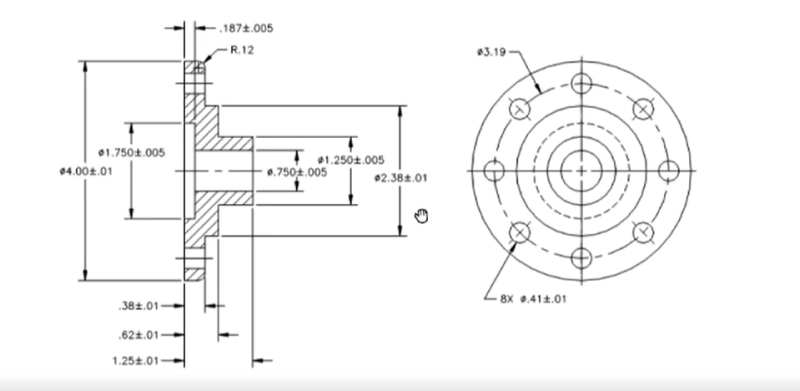
Protocase Blog: Manufactured pieces can differ in size and dimensions from an original CAD model due to variations in the manufacturing processes. To optimally control and communicate the allowable variations, engineers and manufacturers working under the American Society of Mechanical Engineers (ASME) standards, use a symbolic language called Geometric Dimensioning and Tolerancing (GD&T).


1 comment:
The geometric dimensioning and tolerancing language seems to be useful in some cases in a theatrical context. I’ve used it in a robotics setting before for simple systems that had specific priority on some tolerances over others, in which case it was useful for conveying the function right alongside the form in drafting. I think that acknowledging the intended manufacturing process and its tolerance and ‘slop’ is vital to have clean, functional parts. It’s also great on the machining end of things, given that there can be a deeper understanding of what this part will be in context to other parts. A product can only be as good as the tools used. The symbols in GD&T are simple and in my opinion pretty intuitive. I’m wondering how commonly this is used in a regional theatre, commercial theatre, concerts, events, etc setting. I’m also wondering about other potentially applicable American Society of Mechanical Engineers standards in the world of theatre.
Post a Comment