Pittsburgh Arts, Regional Theatre, New Work, Producing, Copyright, Labor Unions,
New Products, Coping Skills, J-O-Bs...
Theatre industry news, University & School of Drama Announcements, plus occasional course support for
Carnegie Mellon School of Drama Faculty, Staff, Students, and Alumni.
CMU School of Drama
Thursday, November 06, 2025
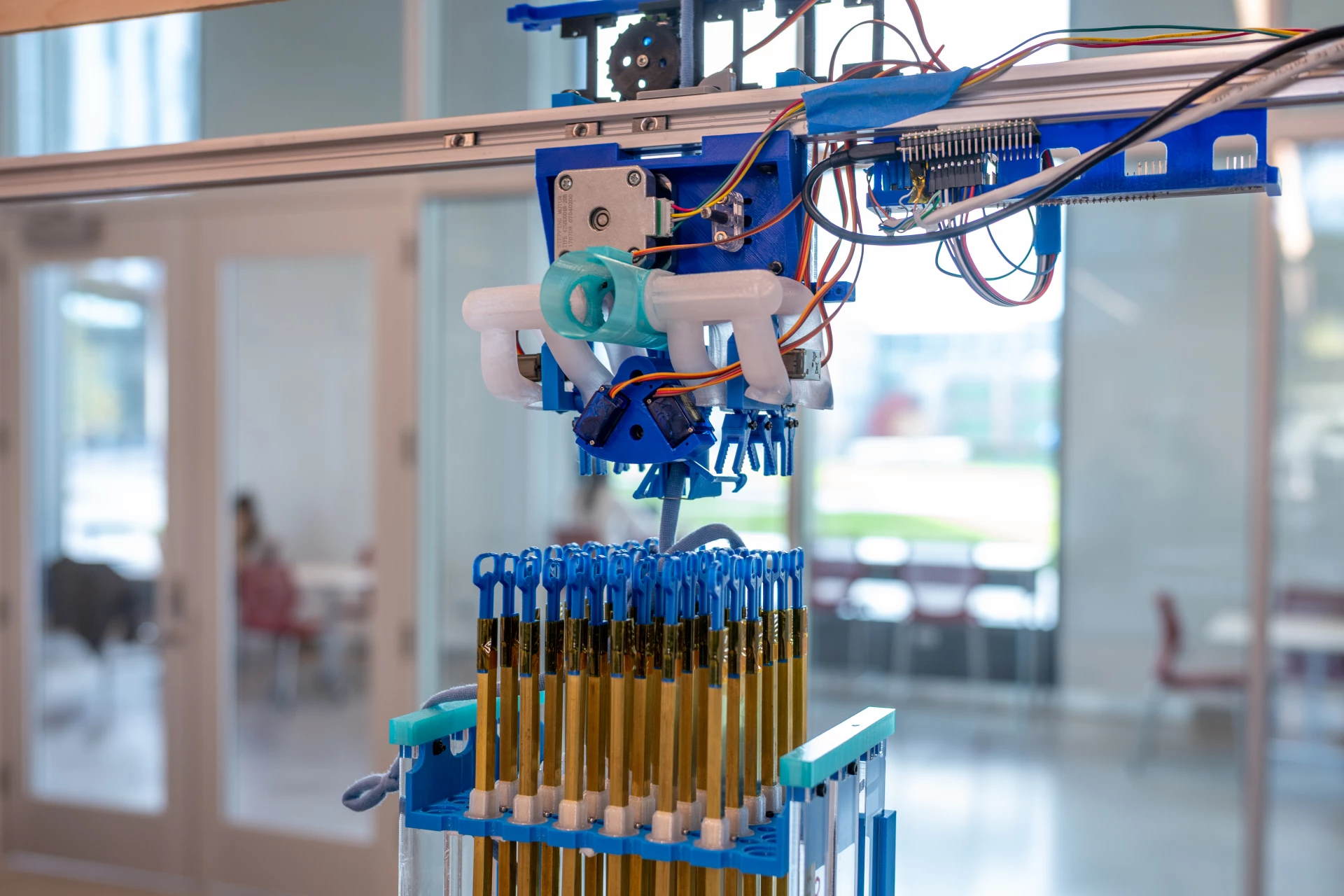
New 3D knitting machine creates solid objects with conventional yarn
newatlas.com: If you find 3D printers to be just a little too coldly futuristic, this contraption might be more to your liking. Scientists from Cornell University have created a machine that knits solid 3D objects out of nice old-timey conventional yarn.
8 comments:
Josh Hillers
said...
While it seems that this technology is still in its earlier stages of development as it doesn’t have the accuracy to complete its tasks without assistance or fixing some errors of the machine, this is still incredibly impressive and an interesting jump for fabrication with the kinds of items it can create. An immediate jump is for manufacturers to potentially use this for knitting projects, but I wonder how long it will take to reach the speed and accuracy of those who are skilled in knitting and how the design process for that would work. Further, I wonder how far the technology can go at the present moment with the operations it can do - can it tie elaborate knots in addition to doing the knitting work described in the article? What dexterity does it have for these kinds of operations and is there any potential application for knot tying or small rigging projects (once again, not that it would be more efficient than tying your own knots).
I had seen this story on the news before and maybe it was one of the other knitting “3d printing” machines but it is incredible what you can do.. The limitations on flexibility and strength along the print lines would be nullified here but the available design and detail is still quite limited. The fact that it is possible is amazing. I do not know how much this differs from commercial sewing machines or if the current ones can knit at all or just produce flat fabric or garments. As the technology progresses throughout its multiple points of development it is interesting where it will take it. Whether that be custom fabrics or supporting medical development and healing it will be fascinating to see how it develops. Some of the other developments are interesting… I wonder if solid furniture or maybe as a padding for other furniture would be. I bet it would be awful to clean but at least novel.
I continue to be fascinated by all of the new types of 3D printers that are appearing on the market. I will say that a yarn 3D printer is not what I expected to see next, but it is very interesting. It makes me think that down the line there could be a 3D printer that will be able to print low cost clothing for people are the world. Now although it dose seem like this article is more focused on saying that the technology is possible instead of saying it exists it is still a step in 3D printing technology. This technology shown in this article is far away from 3D printing clothing, but it shows that the possibility exists. The 3D printer I am waiting for is something that knocks on the door of a food 3D printer, as that would really be knocking on the door of fantasy versus reality.
As a fiber artist the different ways that we use the medium are so intriguing. I never really thought about knitting as being only a flat design, but that may be because as a crocheter and knitter I had been used to creating things in 3D because I think of things like shirts, hats, and gloves to be 3D objects that are sometimes worked in a way called “the round” in which instead of going side to side and turning the work, you go in a circle or whatever is the design shape. Seeing that they have developed a machine to do what I thought had been done for years by clothing factories is interesting. The end of the article made me wonder if they are actually testing the machine as a way to potentially knit together fibers (possibly tendons and ligaments) for medical purposes and less as a structure to be used for clothing.
I think this knitting-based 3D printing machine is really fascinating because it blends something that feels very traditional and human, like yarn and handcraft, with cutting-edge fabrication technology. I usually associate 3D printers with plastic, sharp edges, and a kind of cold futurism, so the idea of using yarn instead actually feels warmer. Even though the device is still slow and makes mistakes, I like that the researchers are focusing on the expressive possibilities and material flexibility rather than just efficiency. The thought that this could eventually create structures for medical uses, like scaffolding for ligaments or veins, makes the project feel even more cool. I really think it shows how a craft associated with patience and care can intersect with innovation in a really thoughtful way. I’m curious to see how the machine evolves, especially whether it will ever match the intuition of human hands.
Wow I hadn’t ever thought about a 3d knitting machine like a 3d printer before. this is really a cool idea, that I think could be potentially very useful in the future. Despite the fact that it seems as thought this machine is still very early in it’s development I think that they are on track to making something very useful. yarn has the potential to make some really useful stuff, and can be created using recycled materials, both textiles and plastics. the idea that the machine can weave complex patterns using string into 3d objects is so fascinating. When 3d printing was first becoming a thing we could actually do, people talked about it as if it was going to revolutionize how everything was made, and while this didn’t actually become the case 3d printing is still very prevalent. I think this knitting machine will have a similar effect where it’s super useful but not something that impacts a ton of systems or anything. I’m still so curious to see how this continues to evolve and be developed.
It’s interesting to see the cycle of new technology at first seeming to have nothing to do with the traditional ways to do things but later incorporating more and more of the old into the new. This is an interesting way to get around the challenges of FDM printing by accepting that there will be points where the material you’re working with (in the case of FDM plastic but in this case yarn) where one part (layer in FDM or string in yarn) will be differentiable from another. Rather than focussing on trying to hide layer lines this shifts to a form factor that was already thought up to account for the lack of continuity between the different strings. It feels like since I first heard about 3d printing there was a ton of theorizing about how it could be used to print artificial organs for transplants. I think that it will be interesting to see if this new technology is able to bring that idea into fruition. Also, on a side note it feels symbolically fitting that the first prototype of a new 3d printing technology is built primarily out of 3d printed parts.
I am probably one of the biggest fans of 3D printing. It is something that I truly believe has revolutionized engineering, manufacturing and home DIY projects. In fact I own short of 30 printers, I use all of them at the Chesky audio factory to produce the speaker shells for the cabinet. I think it is really cool to start seeing the new interactions of what people can do with this concept and to now get yarn, something that is not very strong and hard to support to be able to weave itself and be fully automated. I also think that the future of this will be quite interesting. As mentioned in the article, there could be big medical uses for this. That is something that could really be great to have something like this be put to use for! Overall, I strongly believe the future is 3D printing!


8 comments:
While it seems that this technology is still in its earlier stages of development as it doesn’t have the accuracy to complete its tasks without assistance or fixing some errors of the machine, this is still incredibly impressive and an interesting jump for fabrication with the kinds of items it can create. An immediate jump is for manufacturers to potentially use this for knitting projects, but I wonder how long it will take to reach the speed and accuracy of those who are skilled in knitting and how the design process for that would work. Further, I wonder how far the technology can go at the present moment with the operations it can do - can it tie elaborate knots in addition to doing the knitting work described in the article? What dexterity does it have for these kinds of operations and is there any potential application for knot tying or small rigging projects (once again, not that it would be more efficient than tying your own knots).
I had seen this story on the news before and maybe it was one of the other knitting “3d printing” machines but it is incredible what you can do.. The limitations on flexibility and strength along the print lines would be nullified here but the available design and detail is still quite limited. The fact that it is possible is amazing. I do not know how much this differs from commercial sewing machines or if the current ones can knit at all or just produce flat fabric or garments. As the technology progresses throughout its multiple points of development it is interesting where it will take it. Whether that be custom fabrics or supporting medical development and healing it will be fascinating to see how it develops. Some of the other developments are interesting… I wonder if solid furniture or maybe as a padding for other furniture would be. I bet it would be awful to clean but at least novel.
I continue to be fascinated by all of the new types of 3D printers that are appearing on the market. I will say that a yarn 3D printer is not what I expected to see next, but it is very interesting. It makes me think that down the line there could be a 3D printer that will be able to print low cost clothing for people are the world. Now although it dose seem like this article is more focused on saying that the technology is possible instead of saying it exists it is still a step in 3D printing technology. This technology shown in this article is far away from 3D printing clothing, but it shows that the possibility exists. The 3D printer I am waiting for is something that knocks on the door of a food 3D printer, as that would really be knocking on the door of fantasy versus reality.
As a fiber artist the different ways that we use the medium are so intriguing. I never really thought about knitting as being only a flat design, but that may be because as a crocheter and knitter I had been used to creating things in 3D because I think of things like shirts, hats, and gloves to be 3D objects that are sometimes worked in a way called “the round” in which instead of going side to side and turning the work, you go in a circle or whatever is the design shape. Seeing that they have developed a machine to do what I thought had been done for years by clothing factories is interesting. The end of the article made me wonder if they are actually testing the machine as a way to potentially knit together fibers (possibly tendons and ligaments) for medical purposes and less as a structure to be used for clothing.
I think this knitting-based 3D printing machine is really fascinating because it blends something that feels very traditional and human, like yarn and handcraft, with cutting-edge fabrication technology. I usually associate 3D printers with plastic, sharp edges, and a kind of cold futurism, so the idea of using yarn instead actually feels warmer. Even though the device is still slow and makes mistakes, I like that the researchers are focusing on the expressive possibilities and material flexibility rather than just efficiency. The thought that this could eventually create structures for medical uses, like scaffolding for ligaments or veins, makes the project feel even more cool. I really think it shows how a craft associated with patience and care can intersect with innovation in a really thoughtful way. I’m curious to see how the machine evolves, especially whether it will ever match the intuition of human hands.
Wow I hadn’t ever thought about a 3d knitting machine like a 3d printer before. this is really a cool idea, that I think could be potentially very useful in the future. Despite the fact that it seems as thought this machine is still very early in it’s development I think that they are on track to making something very useful. yarn has the potential to make some really useful stuff, and can be created using recycled materials, both textiles and plastics. the idea that the machine can weave complex patterns using string into 3d objects is so fascinating. When 3d printing was first becoming a thing we could actually do, people talked about it as if it was going to revolutionize how everything was made, and while this didn’t actually become the case 3d printing is still very prevalent. I think this knitting machine will have a similar effect where it’s super useful but not something that impacts a ton of systems or anything. I’m still so curious to see how this continues to evolve and be developed.
It’s interesting to see the cycle of new technology at first seeming to have nothing to do with the traditional ways to do things but later incorporating more and more of the old into the new. This is an interesting way to get around the challenges of FDM printing by accepting that there will be points where the material you’re working with (in the case of FDM plastic but in this case yarn) where one part (layer in FDM or string in yarn) will be differentiable from another. Rather than focussing on trying to hide layer lines this shifts to a form factor that was already thought up to account for the lack of continuity between the different strings. It feels like since I first heard about 3d printing there was a ton of theorizing about how it could be used to print artificial organs for transplants. I think that it will be interesting to see if this new technology is able to bring that idea into fruition. Also, on a side note it feels symbolically fitting that the first prototype of a new 3d printing technology is built primarily out of 3d printed parts.
I am probably one of the biggest fans of 3D printing. It is something that I truly believe has revolutionized engineering, manufacturing and home DIY projects. In fact I own short of 30 printers, I use all of them at the Chesky audio factory to produce the speaker shells for the cabinet. I think it is really cool to start seeing the new interactions of what people can do with this concept and to now get yarn, something that is not very strong and hard to support to be able to weave itself and be fully automated. I also think that the future of this will be quite interesting. As mentioned in the article, there could be big medical uses for this. That is something that could really be great to have something like this be put to use for! Overall, I strongly believe the future is 3D printing!
Post a Comment