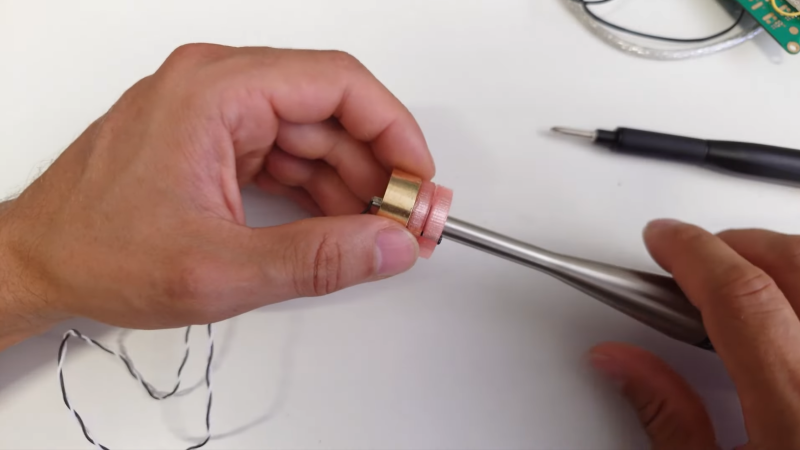
Hackaday: Using a speaker as a microphone is a trick old enough to have become common knowledge, but how often do you see the hack reversed? As part of a larger project to measure the acoustic power of a subwoofer, [DeepSOIC] needed to characterize the phase shift of a microphone, and to do that, he needed a test speaker.


3 comments:
People are constantly using their skills to try new things and change the game. I would have never thought about using a microphone as a speaker but now that I know that it can be done, I am sure there are plenty of uses for it. I do wonder how the idea came up and if it was prompted by the want for it to be used in a performance or if it was just an idea that came from wondering. I think that this could be used in many ways not just for theatrical performances but also for musical performances. I wonder if there is a way for it to be both a speaker and a microphone because that could be useful for musicians and potentially a way for them to hear the band and move around on the stage rather than be tethered to a spot where there is only one speaker for them to hear the band if they do not have headphones.
This is cool to see, but I don't exactly understand the point of it. There's so much effort involved to reverse everything that you basically ruin either a perfectly good microphone or a perfectly good speaker. These things aren't really that expensive, so why not just buy one if you need one. It doesn't make sense to me to do it for fun either? You aren't getting the satisfaction of making anything that's actually worth while for doing this. You're just ruining something that's perfectly fine. Personally if I believe that if you want to start messing around with how sound is recorded or replayed. Make your own equipment. It's actually incredibly easy to make your own speaker or to make your own microphone. At least more vintage ones are easier to make. Anything that as a circuited eq, or a DSP will not be reproducible easily. But making older speakers is actually super possible. Many companies even sell their own DIY speaker or microphone kits. It's a great way to get a better understanding, and more useful than ruining a speaker or microphone.
As someone who deals with speaker drivers everyday, this was something I had heard of. it is definitely an interesting project but at the end of the day you should ask yourself, Why? I can understand how people might want to use a subwoofer driver as a mic because of its properties of being able to have a much more damped and low frequency sound which I guess some people like. For me, growing up in a recording studio I will always prefer the sound of a "normal Mic". I am interested in whether this will change depending on the type of microphone used. If it is possible to get the same effects with maybe something like a ribbon microphone. I think that would be very interesting because something like ribbon mic the ribbons are much lighter so maybe you will not only get a larger freq response but also lower harmonic distortion.
Post a Comment