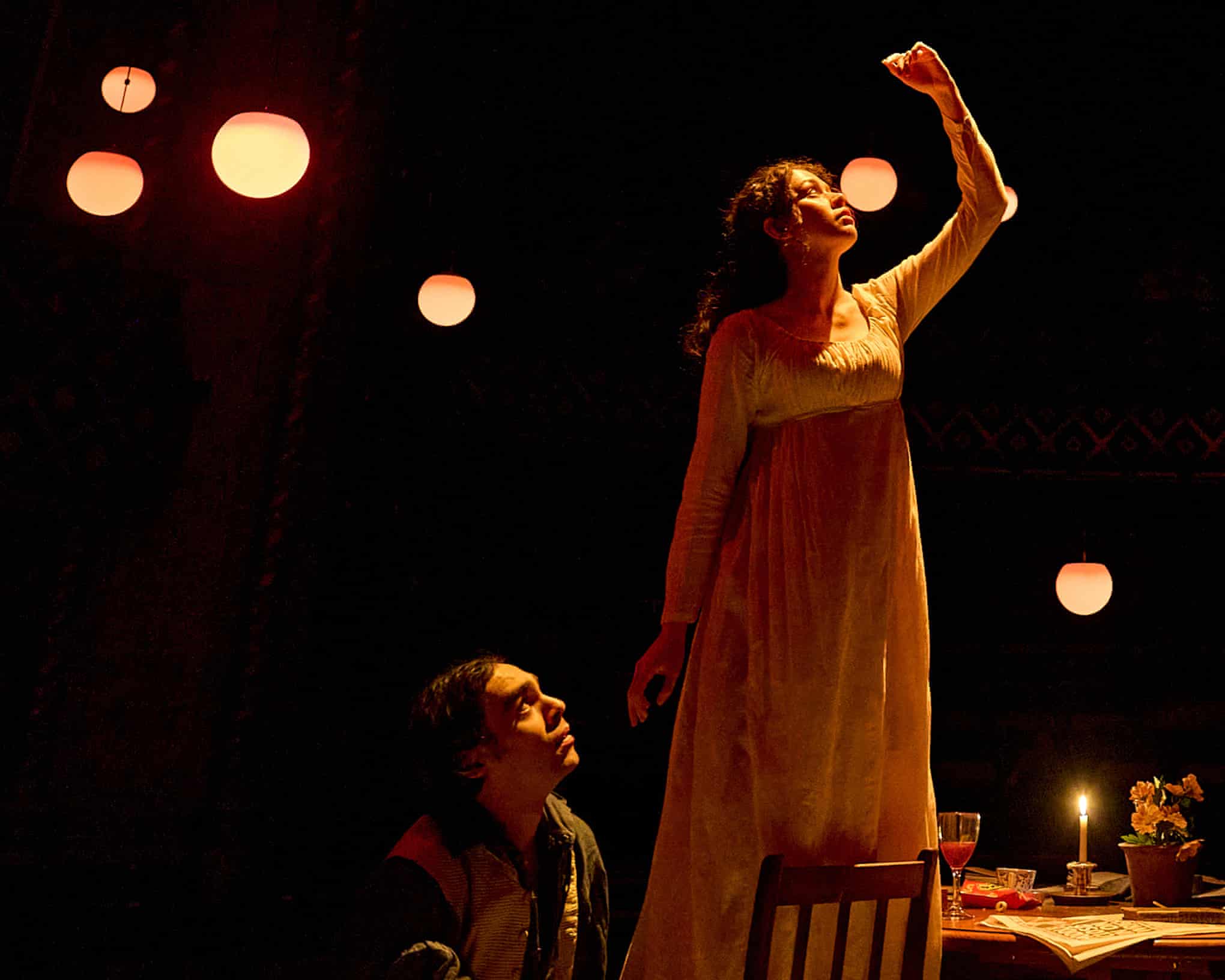
Stage | The Guardian: When Tom Stoppard was asked what this play was about, just as it streaked its meteoric path from London to New York in the 1990s, he called it a drama of romance, mathematics, landscape gardening and Byron. It doesn’t quite cover it. Often regarded as his finest, Arcadia is about life, the universe and everything, to borrow a phrase.


4 comments:
This was an interesting read, especially considering that we open our own version of Tom Stoppard’s Arcadia later this week. I wasn’t aware that it was set across different times, and that will certainly add an interesting dynamic to the play. I’m really curious to see how the creative teams portray the time change on the set and with lighting and sound elements. It’s also been awesome to watch our production come together in the Helen Wayne Rauh Studio Theatre, as I was able to work on loading in both the lighting and scenic elements. The description of the London set turning having some kind of cosmic element is really fascinating to me. I wonder how that was incorporated into the set at the Old Vic, as the whole set is being described as having a slow, almost imperceptible revolve. I imagine that means slow rotation, but if so, I would be curious to see how the set changes with time.
The idea of viewing a singular space through time reminds me of a comic I once read titled “Here” which has been recently turned into a film. Viewing different interactions and relationships through the lens of the space they are in is definitely a through line in stories like these. I find the differences of tone from the past to the present to be an interesting addition to the story as opposed to distracting from each story. It helps the audience to see the past through the lens of the present and feel connected to the researchers as we experience the story of the past with them. I find that moments of comedy can help to balance out serious moments in media, like in the movie Get Out where there are side story breaks to follow the progress or the quirky side character.
This article jumped out to me after having just seen the SoD production of the show Arcadia. The show was visually beautiful and the cast was fantastic. Reading this article really captures the intrigue of the show and the way it keeps you on the edge of your seat. I really loved the visual lighting change between modern day and past. With the cooler lights showing the fluorescent and led light that are so common now and the warmer lights representing the incandescent and candlelight atmosphere of the past. The characters of both the modern day and the past are truly hilarious and the scenes in which they overlap create a very interesting parallel for the audience to watch. I like that there are these two really important parts of the play that exist entirely offstage, Lord Byron and the garden, as they say in the article. It builds on the mystery for the audience that the modern day characters are trying to solve.
I saw CMU Drama’s rendition of Arcadia (opening night) this past week and it was breathtaking. I had skimmed the script beforehand, but purposefully stopped around the ¾ mark to leave the ending a mystery. The article says it works toward a conclusion that never comes, and in a sense, I disagree. The story discusses entropy and the tendencies of heat at length. Thomasina’s early death by fire is upon us at the end, but never seen. The chaos of fire represents the very theories she was working toward up until the end, alongside her passion for them. That is its own conclusion, in my eyes. The article is also against the modern day crassness (that I see to be inherently British, but is easily translated to American performance), but I see that to be proving a point. While our mannerisms and language have changed, the human tendency to progress and the inherent want to learn has not. I believe that Stoppard eloquently claims that drive to be the most vital part of humanity, given almost if not all characters are proponents of this, in a way, whether negatively or positively - which is subjective.
Post a Comment