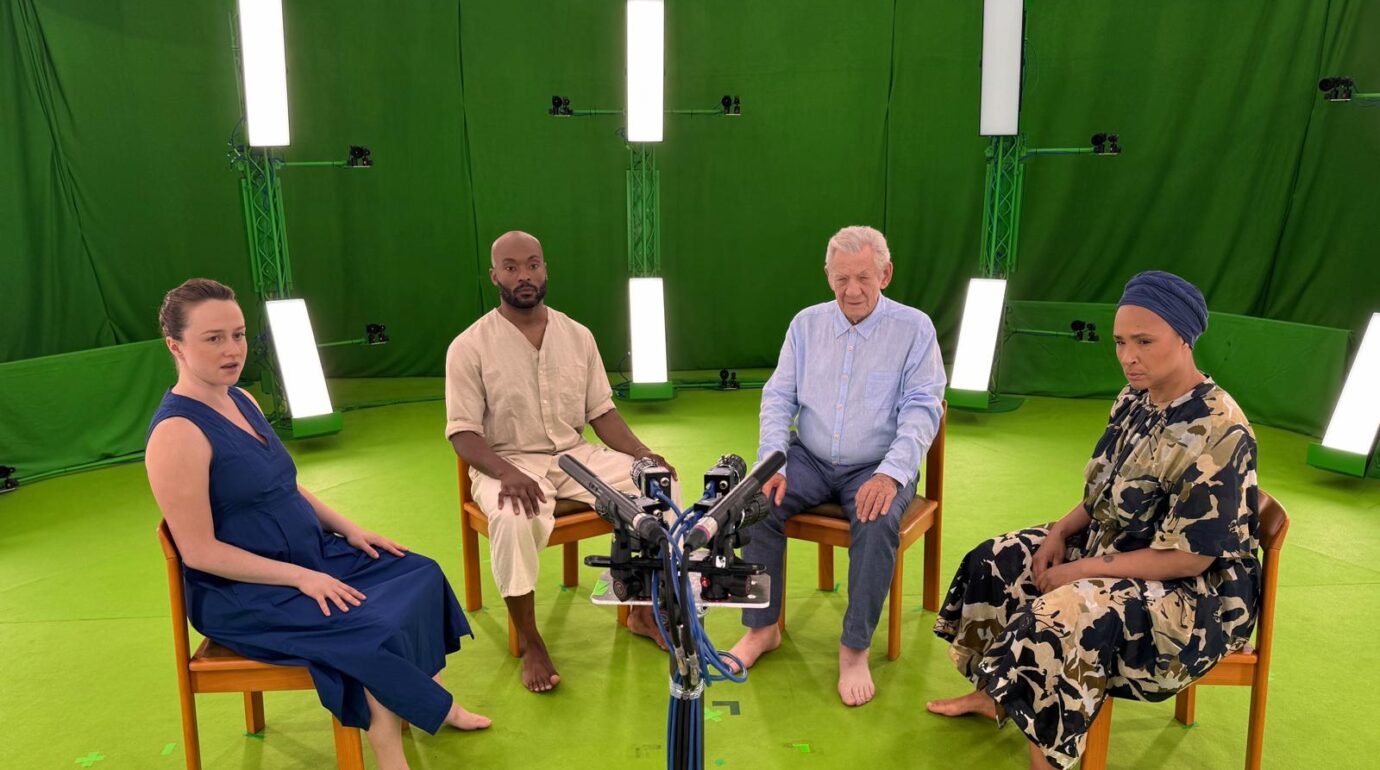
AMERICAN THEATRE: As An Ark opens, actor Golda Rosheuvel enters stage right and sits down in one of four chairs. She looks directly at you, maintaining deep, expectant eye contact. She smiles at you and nods understandingly. Do you smile back? I did. Almost involuntarily. A human reflex: subconscious mirroring.


7 comments:
It is an interesting piece to learn about. I had imagined future theaters implementing VR technology, and the Ark captures part of my vision. However, the playwright is still making his point of delivering this kind of art both individually and collectively, which I believe is hard for a virtual experience. The collective and immersive point seems controversial when we learn the nature of this new kind of art with virtual figures performing in front of the audience. The fact that nothing can be modified after previews for this show, since the whole piece is recorded motions, is restricting this form of art from being an immersive experience for the audience. It seems like the audience is only watching a projected video of a seemingly real figure performing in their sight. This new form of art kind of buries the line between video/film/media and theater. I wouldn’t consider it as theater, since the actor’s energy level couldn’t be modified after certain responses from the audience. That onstage effect is not happening in the Ark. I will be excited to hear more from these new intersecting experiments between art and tech.
I thinks it really great to see a performance experimenting with something new and unique, ive always assumed that eventually a lot of performances would utilize vr but i think ark seems like a cool take on mixed reality media. Its a unique take on a live performance without any live actors and i think that has a bunch of possibilities to do a lot of interesting things( i also do wonder if this vr experience would fall under video and media design in regards to theatre i think it would provide interesting challenges to designers and let them try new techniques or experiment with a lot of cool concepts). I can see how people would think this is a bit gimmicky( which is what a lot of people think of vr in general- people tend to lose interest in a lot of things including vr) however if done well i think it could be really immersive, i also do think that these types of performances and traditional theatre can exist in the same period without stepping on the other’s toes, its good to have theatre performances outside of the norm otherwise things would get really boring
I've often heard it be said that the thing that sets live theatre apart from any other art form is audience reception theory: the back and forth between the audience is what makes theatre unique. Whether it be as simple as a performer leaning into an aspect of the performance that the audience is particularly receptive to on one night, changing the emphasis on lines to catch up an audience that has missed some plot points, or any number of minute differences from night to night no two shows are the same. For that reason while the creators of *An Ark* insist that the communal experience makes it theatre I would still put this production in the same category as film. While you experience it communally with the audience members around you the performance itself is fixed like you're watching a movie in the theaters. I of course am still excited to see where this technology goes but am skeptical that it will see wide spread adoption. But I think that the narrow scope of this technology might be what gets me excited for it. So often tech companies try to redefine or revolutionize but in this case even the creators are upfront that they do not expect this to replace live theatre. I think that there will be many possibilities for a technology like this that don't necessarily clash with the existing art forms. While I don't know the full capabilities of this technology it would be interesting to see if it could augment the scenery around the performers rather than adding performers to the scenery. In that way the scenery could shift depending on who views it (and whether they are wearing the AR glasses) potentially creating meaningful differences in the story. It will be interesting to see how this technology evolves.
While I am interested to see how tech is implemented into theatre, I'm not sure that this really counts as 'theatre'. It is definitely an extremely interesting, original, and creative experience, but the lack of any live elements makes me wonder if it's more of an evolution of movies or TV than it is an evolution of theatre. However, I think that the ideas behind it could make it an interesting new form of media entirely. After all, it does have distinct differences from film or tv. While it might not have theatre's differences between performances, it was also not cut or edited beyond the initial performance. It's really interesting how the creator wants it to remain a communal experience and won't sell the rights to tech companies. It sets the standard for staying true to your beliefs, as I am sure he is being offered quite a bit of money. I am also really impressed by how they took their new medium and its flaws, and used them to the benefit of the story. Using the uncanny valley effect to give the viewer the impression that they are in some sort of limbo was very creative.
This is an extremely interesting production to learn about and I hope I’m able to catch it before its gone. I would have never thought of something like this I don’t think, but I can definitely see how this could be a new, exceedingly interesting type of production. There are so many ways to play with mixed reality and this is pretty revolutionary. The way it can make the audience feel more intimately connected to the content of the production is not lost on me, and I think that can lead to the production of some really special, new, and spectacular stories and works of theater. The illusion of being addressed by the actors or having them perform specifically for you creates more immersion and thus emotional attachment, which I think can be used in various ways to pull on a heartstrings. I’m excited to see ho this technology is used in the future.
Technology is ever changing and ever growing. I am always impressed by people who take technology and use it in a new and exciting way. I enjoy watching old dogs learn new tricks like Sir Ian McKellen. When people who are used to doing things a certain way, and are very good at doing things that way, adapt to new methods and new technology, I gain a lot more respect for them. I thought the legal aspect of this show was interesting. Sir Ian McKellen making sure that his likeness will not be used for random things after he dies is so telling of the world we live in now. With the rise of technology and the rise of new versions of technology, there are a lot more things we need to think about in regards to human rights and rights to their likenesses. But when it is handled correctly and in a way that is respectful, new technology can be incredibly cool.
The concept of a augmented or mixed reality theatrical production is something that I have not seen before. It is something that at this point in the technological advancement of of our world that I should have expected to come to theater. Despite that though it is something that I personally am having a hard time imagining in the world of theater. I have always thought of theater being presented to an audience, and by concept an audience has multiple perspectives. Adding mixed reality to theater is basically giving the theatrical creators the ability to control the perspective of each audience member with a fine took comb. I am not sure how I feel about this concept, and I more see this as a film production than a theatrical production. Especially due to the fact that each audience member is truly seeing a virtual image and not an actor on a stage in front of them.
Post a Comment