Broad Street Review: This is what happens when creatives collaborate. Soft/Cover displays almost 50 years of work from the Fabric Workshop and Museum’s Artists-in-Residence program, in which artists from varied media explore fabric and screen-printing, supported by FWM studio artists. More than 65 works, produced from the 1970s to the present, including newly commissioned work from current residents, unfurl across galleries on three floors.


7 comments:
The incredible artistry that comes from collaboration across mediums always amazes me. I especially when the end medium is not the primary medium of any of the collaborating artists. I find the art is often another step up in innovation, likely because the artist did not have the background of the “rules” or standards in that medium. I also love the knowledge that some learning went into the creation of it. Some learning goes into all pieces of art, because no creation is the same, however figuring out how to work with a new medium adds another layer to it. I think for me, that also comes back to how I feel when figuring out something I’ve never done before. There’s a certain kind of joy that comes with expanding my knowledge into new artistic territory, and I think that somewhat translates when I am looking at art as well.
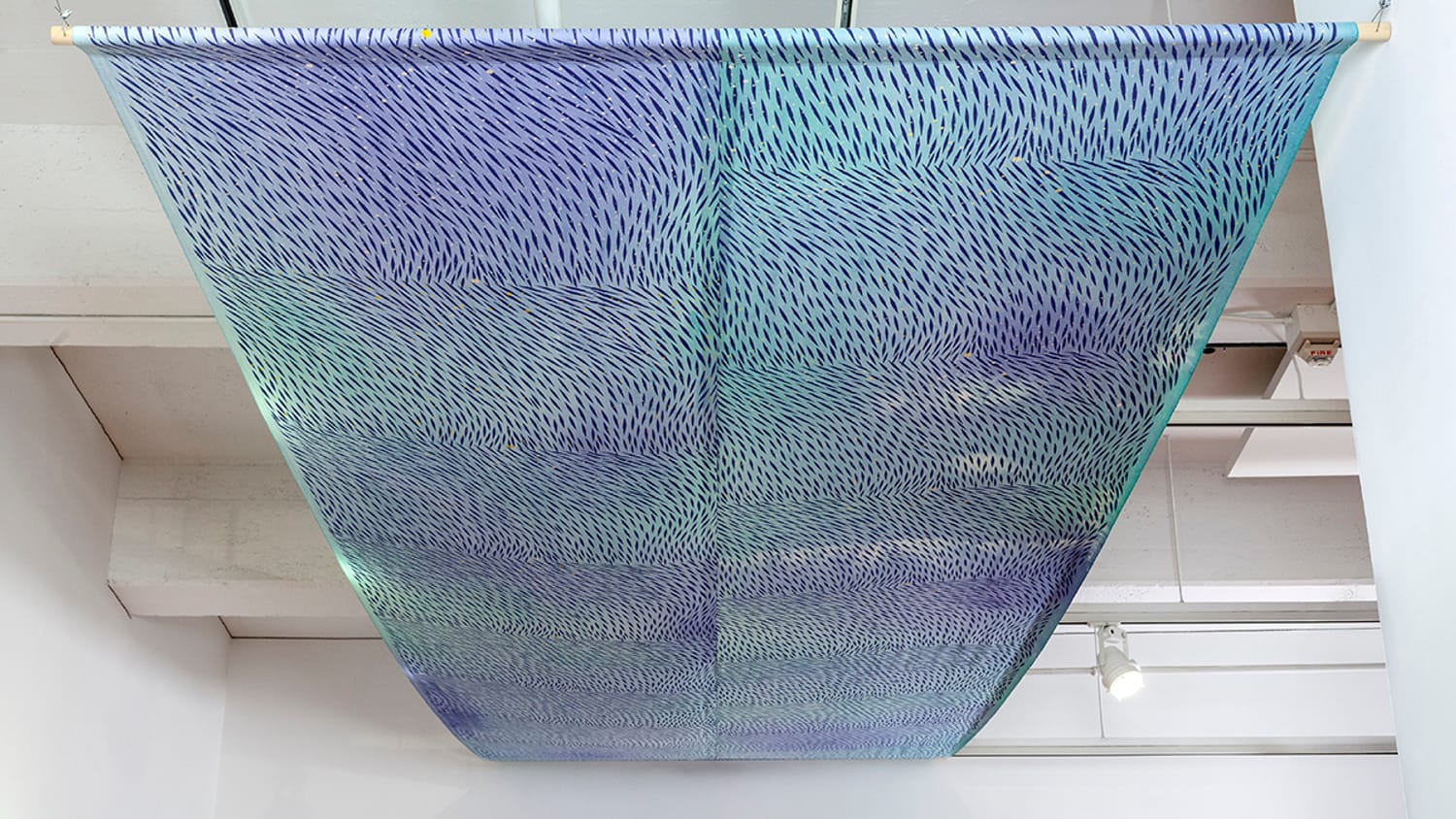
These fabric projects were really cool I've seen fabric projects all around Purnell recently, like dying fabrics and color and pattern and using fabric as the medium to sort of create that, so when I saw this post, I really wanted to read about this Museum exhibit, it looked super cool they were all really different and sent really different messages which I thought was so entertaining it's really cool how one medium can be used in so many different ways to send a different message, but this was so cool I was really intrigued by the Setting the mood exhibit it was just really beautiful the color choice the pattern choice the location of where they hung it just really caught my eye, and it was very pretty. I also loved the feminist bodies at work exhibit. I thought it was really powerful, especially how they made it into a sort of dress-like thing and then the wording they used, and it was very impressive.
This kind of fabric dyeing is absolutely beautiful, I find the fact that it is being showcased in a museum sort of fashion wonderful. It's not often art in any shape or form aside from classical becomes widely acknowledged in a significant way, but by creating a museum atmosphere, it helps establish more credibility to the artists from the perspective of a non-artist than just seeing someone post about it online. I really love how these artists are taking on how fiber arts are so commonly considered feminine. I love how they tie in the common social expectations of women in our modern society with the vintage clothing as a way to show how old fashioned household stereotypes for women are. I hope more museums pop up like this one with less conventional forms of art to help increase the exposure these artists get. My personal favorite piece of the ones shown is Going Under, Shhh.
As someone who partakes in a lot of textile crafts, I absolutely adore textile art in all forms, and find that it creates some of the most powerful and inspiring art that I see. Sewing, quilting, lacemaking, knitting, crochet, embroidery, etc., all of these artforms are so deeply connected to a history of being ladylike homemaker pastimes, and not genuine mediums for creating art. The amount of time, effort, practice, and skill required to create anything with any of those mediums is no joke, and it is always really cool when I get to see them on display, being treated like the genuine pieces of art they are. Artists who not only have the skill to do the craft, but also the design and creativity sense to create beautifully thought-provoking pieces are so amazingly talented. The other thing that’s really cool about all of those crafts is how long they have been around, and how interconnected we as modern textile artists are with ancient ones. One of my favorite tidbits of information is that some of the earliest artifacts of knitting are 12th century geometric colorwork toe-up socks from Egypt, and with how complex they are, they clearly aren’t the earliest time we as humans figured out knitting. Despite all the holes and age, those 12th century socks look exactly like today’s geometric colorwork toe-up sock patterns. Me, somebody’s grandma on Youtube, somebody making aran sweaters in the 60s, somebody making traditional fair isle patterns, somebody who’s an expert at Norweigan knitting, anybody anywhere, we’re all making things with just knits and purls like we always have and that is really cool.
The art of pattern and fabric making is almost viewed as a dying art so it's always enthralling to see exhibits portraying the fabric as an art. Many of the exhibited pieces are bold and have a clear storyline and message behind them. While viewers can easily relate to each artwork because fabric is something we all share as a life experience. I particularly liked her piece Restless Sleeper/Atomic Shroud because it encompasses such a devastating topic with a simple and relatable icon. Such a large part of art is connection and I think this exhibit allows just about anyone to create a connection with the stories being told through a shared experience. I also liked her particular emphasis on creating an environment in which she exhibits her work. The classic white clean pedestals that many “fine art” exhibits find themselves in don't tell everyone's story. So changing that environment to tell each story can be the difference between good and great art.
It was so cool to read about the different artists involved in this exhibition! One piece that really stood out to me was Robert Morris’ Restless Sleepers/Atomic Shroud (1981). I really like how the different elements of the piece come together to not only signal restlessness through visual signs, but through the actual shape of the object. Like many other works of contemporary art, a familiar object (the bed) is modified such that it no longer can serve its original purpose, given that it is placed at a steep angle relative to the wall. Just looking at it, I can feel that iif I were to even try laying in it, I would slide right onto the ground. This imagined sensory experience works really well with other elements of the piece that communicate a lack of safety, like the atomic bomb comforter and printed pillows. The purpose of a bed is to provide safety and rest, but the positioning and symbols of this piece render the bed into something that is distinctly restless and unsafe. (I also like that the comforter is partly undone, which in other exhibitions of this piece seems to sometimes be matched by an imprint in the pillows as though someone’s head was just there.)
I think out of all the articles I have read recently, this is one of the most interesting. The ‘I Can’t Believe I Forgot to Have Children’ shirt by Walton immediately caught my attention, and as I continued reading I was impressed by Koran’s work, the ‘Mama Space Suit’. That was such a genius concept, and the combination of both creations and their messages shows how impossible it is to be a woman. Whether women choose to have children or choose not to, we are criticized. I was also intrigued by the other pieces, and I was especially taken with the shade of apple green in the ‘Cardoso Flea Circus’.
After reading this article I looked up the location of the Fabric Workshop and Museum. I was surprised and a little upset to learn that it is in Philadelphia, because I was in Philadelphia a few years ago. If I ever go back to Philadelphia, I will make sure I visit this museum, although this particular exhibit will no longer be there.
Post a Comment