Pittsburgh Arts, Regional Theatre, New Work, Producing, Copyright, Labor Unions,
New Products, Coping Skills, J-O-Bs...
Theatre industry news, University & School of Drama Announcements, plus occasional course support for
Carnegie Mellon School of Drama Faculty, Staff, Students, and Alumni.
CMU School of Drama
Thursday, October 30, 2025
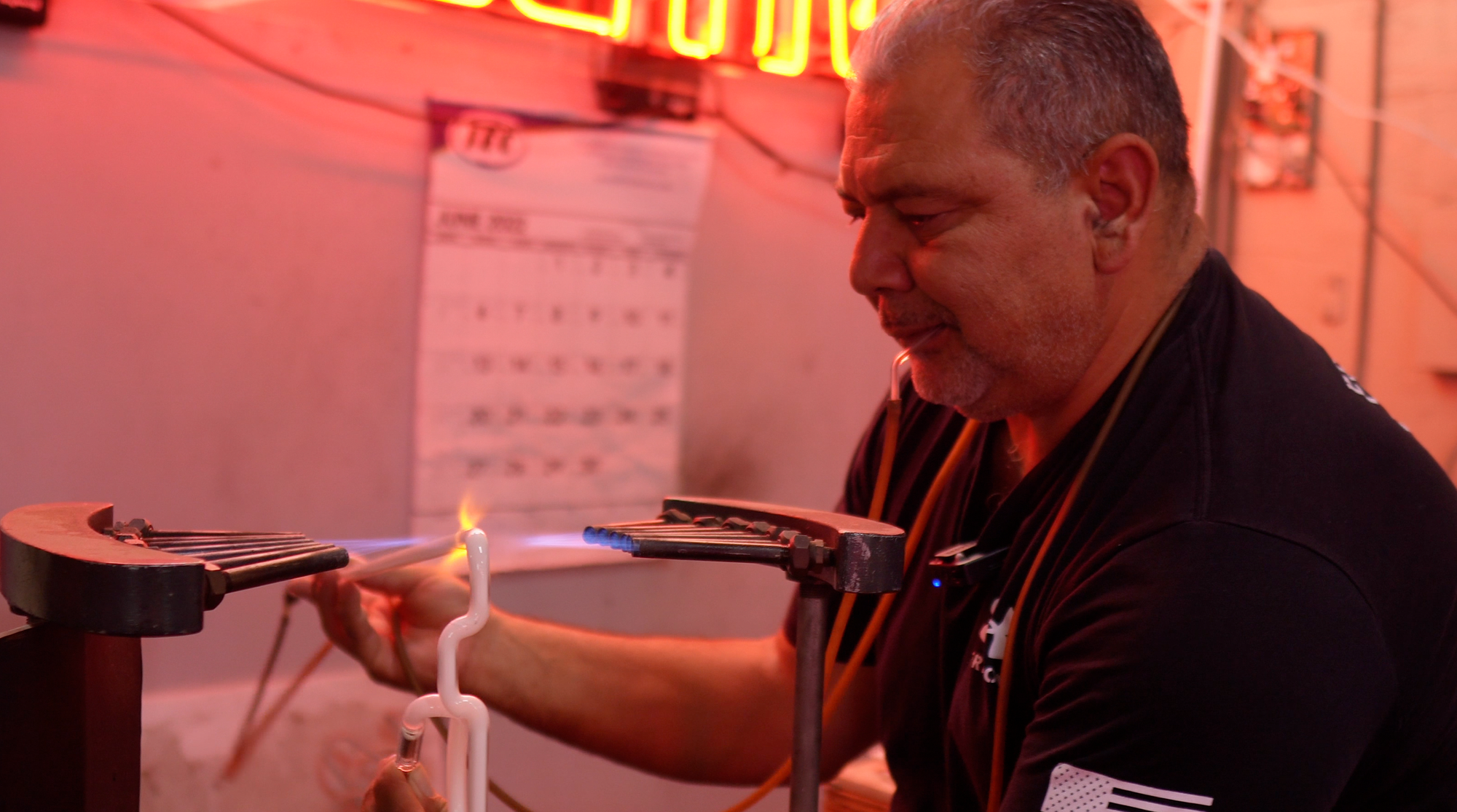
How Artists Are Keeping 'The Lost Art' of Neon Signs Alive
www.404media.co: Next to technicolor neon signs featuring Road Runner, an inspirational phrase that says “everything will be fucking amazing,” and a weed leaf, Geovany Alvarado points to a neon sign he’s particularly proud of: “The Lost and Found Art,” it says.
13 comments:
Emily R
said...
Overall, this was really interesting because I never really thought about the work that goes into making neon signs or even the process. I didn't think they were getting phased out due to the rise of LED signs, and honestly, I would not have known before reading this article. I never thought about the phase out due to it having no effect on me, but I see how it affects and phases out others. You don't run across a neon sign maker every day, so reading about the process and how they have changed over the years was really interesting. I can see why LED signs are becoming more popular due to cost. I haven't ever been able to tell the difference between neon and LED signs, one because I wasn't looking, but also because I don't think I have ever seen them next to each other. If they were side by side, I could probably see the difference based on what the article has described, but also because I have worked with LED before.
Around high school I noticed neon signs trending in boba shops and “hip” new restaurants in our city’s gentrification era. I learned quickly that they were LED signs that were pretty convincing and if nothing else effective at making glowing words and symbols. While I agree neon sign making is an art, I don’t think LED replacements are the enemy the article makes them out to be. LED versions consume less energy, don’t require working with toxic mercury and argon gases, and the use of neon. I think it’s good that people have moved on from using neon signs, but I’m also glad there are artists and shops committed to continue the art on a small scale like how people still keep up the art of scroll calligraphy and making different items from scratch. All that being said, Neon sign making sounds awesome in a non-factory setting and I’m always happy to see a real one here and now.
I absolutely love neon signs. They look really cool, and on top of that, the pure artistry that goes into manufacturing a neon sign is truly impressive. It’s really cool how artists have figured out how to work with such difficult materials. While I understand a lot of the reasoning behind why true neon signs have died out, and why LED fake neon signs have become so much more popular, there is definitely a very special feeling of authenticity in a real neon sign that is kind of lost in an LED neon sign. It’s very similar to how LED lightbulbs are great, but the true warmth of an incandescent bulb just can’t be perfectly recreated. I think it is really cool to highlight artists who do this work, since like all art forms that have been replaced with something easier to do, it is unfortunate to imagine these skills being lost.
Neon signs are just naturally so beautiful, warm, cozy, bright, and hold such a beautiful tone of color saturation. I feel this same way about movies and tv that are shot with real film instead of digital video. Each time I see a store or movie theater with a neon sign I just feel so happy. Neon lights really should be appreciated a lot more. And I completely understand that leds are a lot more convenient, energy efficient, and not cheaper. But the colors have been repeated so many times that I feel like they lose a lot of lighting impact. But I will admit that it is important to be more energy efficient at all times. Especially when it's cost effective. However, I think it's really cool that neon art and the production of neon signs are turning into a craft and artform. I just wish they weren't so expensive because they are absolutely gorgeous.
I adore a good neon sign. They are truly a beautiful piece of art, with so much effort going into making them detailed. I also do think that the LED version of them can be very beautiful as well. They're so much more practical; the real neon signs are very fragile and very difficult to make, while the LED ones are far less expensive. That being said because the signs that are actually Neon are so difficult to make a lot of care has to be put into them, and if that same level of care was put into creating LED equivalents, maybe they could have some of the benefits like the environmental impacts of the amount of energy they use could be present, but the piece could still be higher quality like a true neon sign. That being said, every time I see a sign that is actually made of neon, I will continue to appreciate that it's an art form that is a rare sight these days.
For anyone who is interested in learning more about this lost art, the Pittsburgh Glass Center has classes on making neon works. I don't take this class, but I take another class in the same Studio room at the center, and it's really interesting to see all of the tools required for such a process. It really makes you think about how hard it is to do that kind of stuff. Additionally, something that's really interesting about neon as opposed to other types of flameworking glass art is that you have to use different sorts of natural gases in different amounts. A practical side effect of this in the studio is that the setups for the hand torches and stationary torches that I use at the studio are always a little out of whack when I get there because of the neon class that was in there previously. I'm not quite sure what the setup specifically looks like for neon, just that it's wildly different from other setups.
This was such an interesting article! I think that neon signs are so cool! I never realized how much work and artistry actually goes into making one. It was particularly interesting when the article described how cheaper LED signage took the place of traditional neon. However, there has been a resurgence by artists and artisans who value the warmth, quality, and repairability of actual glass neon. His attention to detail is extremely evident, burning glass to about 1000 degrees celsius, bending tubes, evacuating air, choosing gases. Hearing how artists like Alvarado see neon not just as signage, but as sculpture and storytelling was really striking. This is a great reminder that the handmade qualities of neon like the flicker, the hum, and its many imperfections are what make it such a special art form. After reading this article, I felt a new appreciation for how neon signs get to look the way that they do.
I never really realized how LED signs are taking over neon signs. I can understand why some companies like McDonald’s are using LED signs as they are more energy efficient, however, for one-off events I believe neon signs are a clearer choice. Just like they mentioned, since most LED signs are used for one-off events they end up becoming e-waste, making them more harmful to the environment. Also, I looked up pictures of both neon signs and LED signs and there was a clear difference between their qualities. While they are both very pleasing to look at, the neon sign had this more authentic feel to it rather than looking at an LED sign, which felt somewhat generic with the plastic frame holding it together. Overall, I learned a lot about the making of neon signs and never really thought about how dangerous it can be. I always assumed they have been mass-produced but instead they are hand-made which I think makes the craft so much better.
I’ve never really been drawn to neon signs personally. To me, they’ve always had a loud, big-city feeling that feels so opposite from nature and the environments I usually find comforting. But reading about Geovany Alvarado’s work made me appreciate neon a little bit more. I didn’t realize how hands-on and physical the craft is, such as bending glass with fire, burning yourself, breaking pieces and remaking them. There’s something very human in that process. I also liked learning how neon can last for years and be repaired instead of thrown away, unlike cheaper LED signs that often become waste. Even if neon isn’t my aesthetic, I can understand now why people see it as art rather than just signage. It carries warmth, history, and someone’s labor in every bend of the glass. This article helped me see neon not as something flashy, but as something personal and handmade.
Despite not being alive to see the golden era of neon signs I’ve found that I absolutely adore them. Even in the modern era it feels like a breath of fresh air to see something built by hand, for a specific purpose, more expensive than it needs to be, but unique. It feels that so often everything must be built by the lowest bidder and look like all the millions of other versions of it that exist in the world. As this article points out neon signs can be easily replaced by cheap LEDs that convey the same information and are increasingly getting closer in quality to actual neon signs. But in a way that makes actual neon signs all the more appealing to me, they weren’t built that way out of necessity, or because it was the cheapest way, they were built that way purely because of the aesthetic of an actual neon sign. I suppose that as a designer I’m biased in my beliefs of aesthetic vs cost but I find that it’s often worth the cost to build something beautiful rather than something cheap and that your investment will come back in the long run.
Neon is one of those eternal American aesthetics that you can’t separate from the culture it rose to prominence in. Hazy visions of 20th century America and LA captured in movies like Boogie Nights provided eternally glowing images of a bright country shining through its own darkness. I think the continuation of this “lost art” is a testament to the fact that the American experiment is not dead yet. When I think of neon I think of The Sound of Silence by Simon and Garfunkel. “The Neon God they made” evokes a man-made testament to our domination of nature and our worship of superficial things. It’s fascinating to me that in our 21st century world, our “neon god” has changed his form to LEDs and youtube slop, leaving neon to become a counter-cultural way of fighting this, if only through fake art. The cycles of art, creation, consumption, and worship will go on forever. Not all is lost as long as these signs are still lighting up the darkest of nights.
I feel like the diminishing population of neon sign artists speaks to a larger issue with interest in the production of physical media. WIth everything becoming automated, including the production of neon signs, consumers have lost the view of goods as art. I saw a video the other day of a person complaining about needing to pay $15 for a woven basket. Someone responded to the video pushing back, asking the other person to think about the work that would have gone into weaving that basket before automation. As these objects continue to have less human hands involved in their creation, society becomes detached from the idea that they ever have been made by people. It just makes me sad to think about. I see the people around me getting degrees that might not even be needed in four years, and I fear for my own career. What will still exist when I enter the workforce?
I love a good neon sign. My drawing professor could attest to this, I have drawn neon before (very hard to find a good reference because everything is LED anymore) and I have tried to use neon in a plethora of other assignments, which she always tries to guide me away from because it is so hard to find a proper reference for. Everything is LED, it’s tragic, and if you don’t know what you’re looking for it’s easy to see a bightly colored sign twisted into a shape and think ‘ooo neon’ and it is infact still LED. There’s a specific glow to a neon sign that isn’t present with LED, and now that I know what the difference is I notice it everywhere. I remember when I was younger I (still infatuated with neon) wanted a sign for myself, but could not get my hands on one since that’s a little bit out of the price range of a middle school kid with a breif little special interest. I didn’t quite understand the jump in price from LED since I didn't understand the work that went into it, but clearly this is a lot of heart gone into Alvarado’s work, and I’m sure many others. It’s always hilarious to me seeing people arguing that a niche craft like this isn’t environmentally friendly when the alternative has to be replaced so frequently it most definitely makes up for it. I just have one question remaining- these burns, isn’t this preventable? What about gloves..? I’m not the one making neon though, I just admire it.


13 comments:
Overall, this was really interesting because I never really thought about the work that goes into making neon signs or even the process. I didn't think they were getting phased out due to the rise of LED signs, and honestly, I would not have known before reading this article. I never thought about the phase out due to it having no effect on me, but I see how it affects and phases out others. You don't run across a neon sign maker every day, so reading about the process and how they have changed over the years was really interesting. I can see why LED signs are becoming more popular due to cost. I haven't ever been able to tell the difference between neon and LED signs, one because I wasn't looking, but also because I don't think I have ever seen them next to each other. If they were side by side, I could probably see the difference based on what the article has described, but also because I have worked with LED before.
Around high school I noticed neon signs trending in boba shops and “hip” new restaurants in our city’s gentrification era. I learned quickly that they were LED signs that were pretty convincing and if nothing else effective at making glowing words and symbols. While I agree neon sign making is an art, I don’t think LED replacements are the enemy the article makes them out to be. LED versions consume less energy, don’t require working with toxic mercury and argon gases, and the use of neon. I think it’s good that people have moved on from using neon signs, but I’m also glad there are artists and shops committed to continue the art on a small scale like how people still keep up the art of scroll calligraphy and making different items from scratch. All that being said, Neon sign making sounds awesome in a non-factory setting and I’m always happy to see a real one here and now.
I absolutely love neon signs. They look really cool, and on top of that, the pure artistry that goes into manufacturing a neon sign is truly impressive. It’s really cool how artists have figured out how to work with such difficult materials. While I understand a lot of the reasoning behind why true neon signs have died out, and why LED fake neon signs have become so much more popular, there is definitely a very special feeling of authenticity in a real neon sign that is kind of lost in an LED neon sign. It’s very similar to how LED lightbulbs are great, but the true warmth of an incandescent bulb just can’t be perfectly recreated. I think it is really cool to highlight artists who do this work, since like all art forms that have been replaced with something easier to do, it is unfortunate to imagine these skills being lost.
Neon signs are just naturally so beautiful, warm, cozy, bright, and hold such a beautiful tone of color saturation. I feel this same way about movies and tv that are shot with real film instead of digital video. Each time I see a store or movie theater with a neon sign I just feel so happy. Neon lights really should be appreciated a lot more. And I completely understand that leds are a lot more convenient, energy efficient, and not cheaper. But the colors have been repeated so many times that I feel like they lose a lot of lighting impact. But I will admit that it is important to be more energy efficient at all times. Especially when it's cost effective. However, I think it's really cool that neon art and the production of neon signs are turning into a craft and artform. I just wish they weren't so expensive because they are absolutely gorgeous.
I adore a good neon sign. They are truly a beautiful piece of art, with so much effort going into making them detailed. I also do think that the LED version of them can be very beautiful as well. They're so much more practical; the real neon signs are very fragile and very difficult to make, while the LED ones are far less expensive. That being said because the signs that are actually Neon are so difficult to make a lot of care has to be put into them, and if that same level of care was put into creating LED equivalents, maybe they could have some of the benefits like the environmental impacts of the amount of energy they use could be present, but the piece could still be higher quality like a true neon sign. That being said, every time I see a sign that is actually made of neon, I will continue to appreciate that it's an art form that is a rare sight these days.
For anyone who is interested in learning more about this lost art, the Pittsburgh Glass Center has classes on making neon works. I don't take this class, but I take another class in the same Studio room at the center, and it's really interesting to see all of the tools required for such a process. It really makes you think about how hard it is to do that kind of stuff. Additionally, something that's really interesting about neon as opposed to other types of flameworking glass art is that you have to use different sorts of natural gases in different amounts. A practical side effect of this in the studio is that the setups for the hand torches and stationary torches that I use at the studio are always a little out of whack when I get there because of the neon class that was in there previously. I'm not quite sure what the setup specifically looks like for neon, just that it's wildly different from other setups.
This was such an interesting article! I think that neon signs are so cool! I never realized how much work and artistry actually goes into making one. It was particularly interesting when the article described how cheaper LED signage took the place of traditional neon. However, there has been a resurgence by artists and artisans who value the warmth, quality, and repairability of actual glass neon. His attention to detail is extremely evident, burning glass to about 1000 degrees celsius, bending tubes, evacuating air, choosing gases. Hearing how artists like Alvarado see neon not just as signage, but as sculpture and storytelling was really striking. This is a great reminder that the handmade qualities of neon like the flicker, the hum, and its many imperfections are what make it such a special art form. After reading this article, I felt a new appreciation for how neon signs get to look the way that they do.
I never really realized how LED signs are taking over neon signs. I can understand why some companies like McDonald’s are using LED signs as they are more energy efficient, however, for one-off events I believe neon signs are a clearer choice. Just like they mentioned, since most LED signs are used for one-off events they end up becoming e-waste, making them more harmful to the environment. Also, I looked up pictures of both neon signs and LED signs and there was a clear difference between their qualities. While they are both very pleasing to look at, the neon sign had this more authentic feel to it rather than looking at an LED sign, which felt somewhat generic with the plastic frame holding it together. Overall, I learned a lot about the making of neon signs and never really thought about how dangerous it can be. I always assumed they have been mass-produced but instead they are hand-made which I think makes the craft so much better.
I’ve never really been drawn to neon signs personally. To me, they’ve always had a loud, big-city feeling that feels so opposite from nature and the environments I usually find comforting. But reading about Geovany Alvarado’s work made me appreciate neon a little bit more. I didn’t realize how hands-on and physical the craft is, such as bending glass with fire, burning yourself, breaking pieces and remaking them. There’s something very human in that process. I also liked learning how neon can last for years and be repaired instead of thrown away, unlike cheaper LED signs that often become waste. Even if neon isn’t my aesthetic, I can understand now why people see it as art rather than just signage. It carries warmth, history, and someone’s labor in every bend of the glass. This article helped me see neon not as something flashy, but as something personal and handmade.
Despite not being alive to see the golden era of neon signs I’ve found that I absolutely adore them. Even in the modern era it feels like a breath of fresh air to see something built by hand, for a specific purpose, more expensive than it needs to be, but unique. It feels that so often everything must be built by the lowest bidder and look like all the millions of other versions of it that exist in the world. As this article points out neon signs can be easily replaced by cheap LEDs that convey the same information and are increasingly getting closer in quality to actual neon signs. But in a way that makes actual neon signs all the more appealing to me, they weren’t built that way out of necessity, or because it was the cheapest way, they were built that way purely because of the aesthetic of an actual neon sign. I suppose that as a designer I’m biased in my beliefs of aesthetic vs cost but I find that it’s often worth the cost to build something beautiful rather than something cheap and that your investment will come back in the long run.
Neon is one of those eternal American aesthetics that you can’t separate from the culture it rose to prominence in. Hazy visions of 20th century America and LA captured in movies like Boogie Nights provided eternally glowing images of a bright country shining through its own darkness. I think the continuation of this “lost art” is a testament to the fact that the American experiment is not dead yet. When I think of neon I think of The Sound of Silence by Simon and Garfunkel. “The Neon God they made” evokes a man-made testament to our domination of nature and our worship of superficial things. It’s fascinating to me that in our 21st century world, our “neon god” has changed his form to LEDs and youtube slop, leaving neon to become a counter-cultural way of fighting this, if only through fake art. The cycles of art, creation, consumption, and worship will go on forever. Not all is lost as long as these signs are still lighting up the darkest of nights.
I feel like the diminishing population of neon sign artists speaks to a larger issue with interest in the production of physical media. WIth everything becoming automated, including the production of neon signs, consumers have lost the view of goods as art. I saw a video the other day of a person complaining about needing to pay $15 for a woven basket. Someone responded to the video pushing back, asking the other person to think about the work that would have gone into weaving that basket before automation. As these objects continue to have less human hands involved in their creation, society becomes detached from the idea that they ever have been made by people. It just makes me sad to think about. I see the people around me getting degrees that might not even be needed in four years, and I fear for my own career. What will still exist when I enter the workforce?
I love a good neon sign. My drawing professor could attest to this, I have drawn neon before (very hard to find a good reference because everything is LED anymore) and I have tried to use neon in a plethora of other assignments, which she always tries to guide me away from because it is so hard to find a proper reference for. Everything is LED, it’s tragic, and if you don’t know what you’re looking for it’s easy to see a bightly colored sign twisted into a shape and think ‘ooo neon’ and it is infact still LED. There’s a specific glow to a neon sign that isn’t present with LED, and now that I know what the difference is I notice it everywhere. I remember when I was younger I (still infatuated with neon) wanted a sign for myself, but could not get my hands on one since that’s a little bit out of the price range of a middle school kid with a breif little special interest. I didn’t quite understand the jump in price from LED since I didn't understand the work that went into it, but clearly this is a lot of heart gone into Alvarado’s work, and I’m sure many others. It’s always hilarious to me seeing people arguing that a niche craft like this isn’t environmentally friendly when the alternative has to be replaced so frequently it most definitely makes up for it. I just have one question remaining- these burns, isn’t this preventable? What about gloves..? I’m not the one making neon though, I just admire it.
Post a Comment