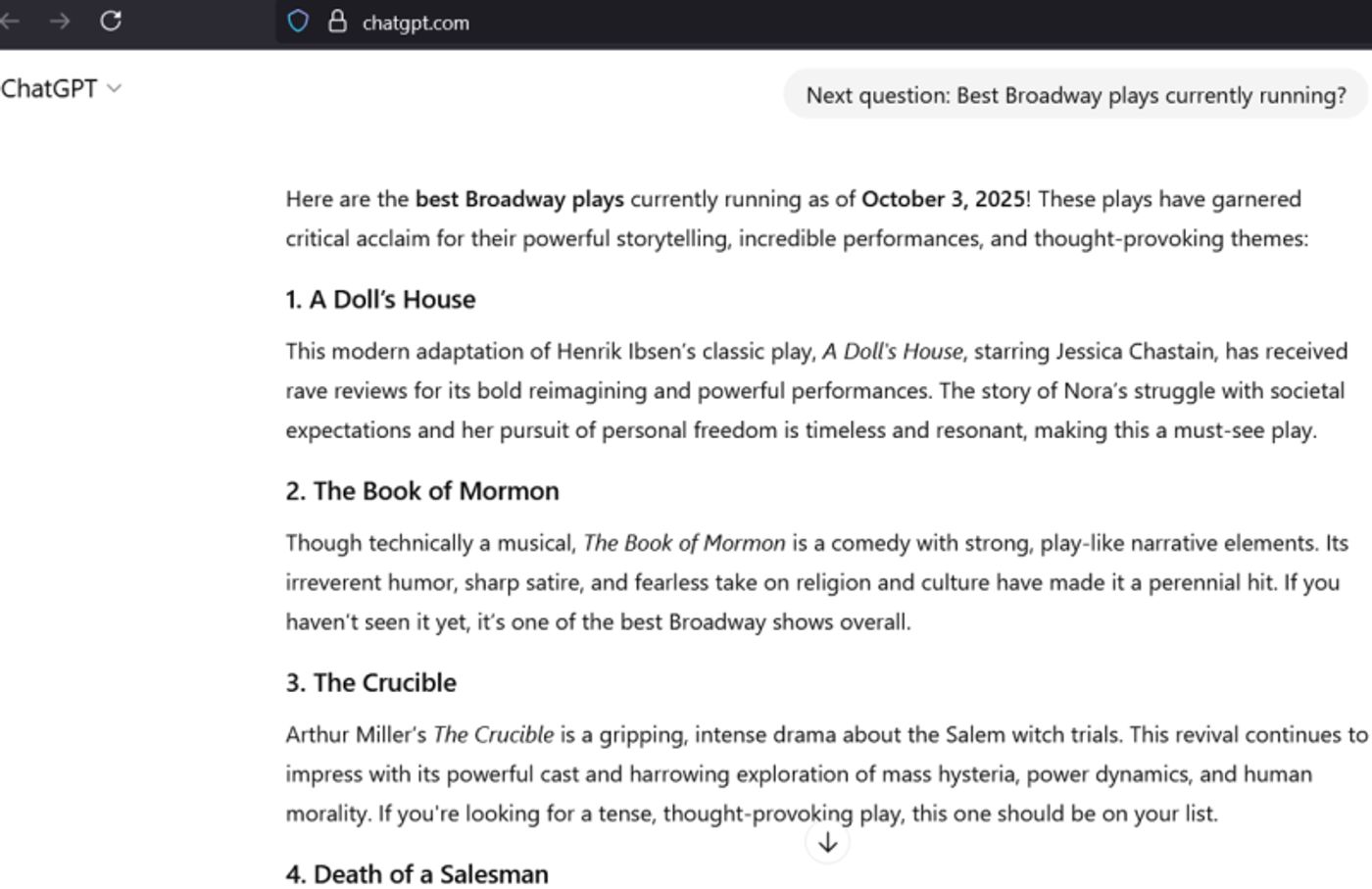
www.broadwayworld.com: Across two test days (October 2 and 3, 2025), Open AI’s ChatGPT repeatedly recommended titles that are closed (e.g. A Doll’s House, Suffs, Sweeney Todd, The Lehman Trilogy), West End-only (e.g. The Devil Wears Prada), or never Broadway/West End (e.g. The Whale). This isn’t a minor accuracy issue – it hypes up to buyers shows they can’t buy a ticket to see.


10 comments:
When thinking about AI in the theatre industry, the thought of job loss comes to mind and not about about on how it affects tickets and revenue. The idea of AI in the entertainment industry has been a scary thought due to how it could severely change the stories told and the jobs given. The idea of it affecting sales falls short because it isn't one of those major things looked at when first dealing with it. As someone who is involved in the theatre community and knows which shows are currently in the Broadway season, it is still a possible that I may forget some or think a show that is finished with its run is still on. Based on the results of the tests, I definitely can see how people who aren't as familiar will be affected and only look at the shows that the generator is giving them. Also, when looking at off-Broadway or regional theatres, I feel like it is most important to have accurate data because they aren't as well off as the commercial industry.
Nobody should be surprised by this. AI very often gives out misinformation and can be very biased. If anyone was paying attention over the past few years, they would know about these hallucinations. AI takes information from all over the internet, and it often cannot distinguish between fact and fiction. That’s why it can’t be trusted as a source of information and must always be double-checked, as you don’t know where its information is coming from. AI is also influenced by its users and learns from them, so it's also not trustworthy because of that, as it could be bending to certain biases, if the people training it feed it misinformation accidentally, then the AI will spit it right back out. I know a lot about this process, and I know that it happens, especially because I have a relative who trains and works on AI and has been for years. This article displays one of many examples of how hallucinations occur and how they can negatively impact people and industries. Stop trusting AI and use it sparingly as a tool or not at all, that's my point.
Yikes… Well, if this article isn’t telling about the current state of generative AI when it comes to reliability, hope may be lost for theatrical audiences. The fact that people are even using platforms such as ChatGPT to recommend Broadway shows to watch is devastating and says so much about how reliable we’ve become as a society, even within the arts, in incorporating AI to our daily life. Theatre is a part of media, media which grows through word of mouth or social sharing. To see that something as simple as recommending popular/well received theatrical titles is being taken over from people to AI is sad. It’s not even surprising that a task, seemingly as simple as this, is somehow messed up or misconstrued by generative AI, given the already questionable state of reliability AI stands in. The fact that it also steals the spotlight from up and coming shows is also depressing because everyone should be encouraged to support smaller works for the better of the industry and community as a whole.
Like most people I'm pretty skeptical about the effectiveness of AI after reading this article. But considering that this model was trained on old data, and many people that use it weren't considering that you could reasonably conclude this could just be user error. I'm actually decently excited to see what things AI can be used for in the entertainment industry. I recently actually saw a new WAVES plugin that can automatically do boost and sweeps for audio systems and I thought that was pretty neat. But of course boosting and sweeping isn't particularly difficult. But it's cool to see what it's starting to be able to do. I think it would be interesting to see if AI could be able to help mixers be more precise with which microphones are on at a time, by picking up when microphones are picking each other up. I think this already exists without AI and I think there are great improvements to be made beyond what already exists.
I think that it is really odd how ChatGPT and AI can get such current information so wrong. I would understand more if it were getting information wrong from a long time ago but all of these shows are the first ones that pop up when you research and look up Broadway shows. This is only going to greatly effect the current and future running shows on Broadway right now, with AI not recommending shows that are currently playing to fewer people will know about the current productions leading to less ticket sales and less revenue for the show and broadway is expensive to produce if they are selling tickets then there is a very high chance that the show will close earlier then expected and if this story keeps happening it could lead to a shut down of broadway and a huge decrease with the arts which it vital to communities.
I recently had a very similar experience to the one described in the synopsis of this article. I don’t ever use Chat GPT or the like for these types of services, as I’ve found them to be unreliable, give weird results, or try to gaslight you into believing that there are magical events happening in fictional places near you. My sister, however, was CONVINCED that Chat GPT was correct about this art exhibition happening at some village green near where I worked over the summer, and despite my not being able to find anything about the event online, she earnestly believed that it would happen at the village green- a place that doesn’t exist- this weekend. Our first problem arrived when we couldn't find the village green, but we found a park with a similar enough name that we figured it would probably be there. Nothing. The AI had buckled down and then tripled down on an event that didn’t exist. Luckily, we hadn’t bought scam tickets or anything of the sort, and we were able to enjoy exploring a nice walk around town, but there are so many worse ways that could have gone. It also really sucks for these businesses and shows that are there, as at least when you’re looking at a human reviewer, they have a chance to recommend something unique or to talk about a lesser-known show.
I don’t think we should be surprised that AI “overlooks” newer shows as it’s a tool built on recycling older, already established media for its purposes. If you’re getting your information on “current” broadway shows from AI I think you have bigger issues to tackle than that you’re missing out on more current productions. Broadway is its own insular media form so it’s no surprise that AI has trouble finding information on it. I don’t think this is a “problem” that needs to be “solved” though. We shouldn’t have to adapt our industry to serve the lowest common denominator of consumers who can’t do the basic research outside of using AI to see what shows there are to see. The shows these AI articles are promoting are just the most popular shows on broadway right now. I don’t mean to gatekeep but if a theater goer wants to see a basic show on broadway then sure they’re going to want to go see The Book of Mormon or Beetlejuice right now. Its the more inquisitive theater goer that’s going to be interested in new shows like Chess or Dog Day Afternoon that are going to go the extra mile (do the bare minimum google search) to find out these shows exist. If anything broadway just needs to market and advertise more to get these shows out there rather than placate the AI media cycle by lowering themselves to that level.
AI is originally trained on information from 2023ish, so this does make sense. While yes, they basically gave chatgpt it’s own computer, it first goes through the information it already has, not the information available online. This just helps them cut down on server costs and they aren’t sending a lot of HTTPS requests that way, if millions of people are asking chatgpt to use the internet to find out sources, that would overload the server as well. I do think this is a challenge thats very hard to solve, as they aren’t giving chatgpt new training information that much anymore, such as the current broadway series, instead they are expecting that no one would ask that or it would know to google it instead of doing it the cheap way. If the author reported it to chatgpt, I am sure this would be fixed, as OpenAI is fixing incorrect information constantly.
This article was both not at all surprising and also incredibly interesting. For one, this article felt like an interesting change from a lot of typical Broadway World articles I read - this article was especially scientific and a really fascinating read. And like I said, the results aren’t surprising. Every time I do a Google search, I am incredibly frustrated with the AI search result that is pushed to the top of the page. It is so incredibly unreliable, and I can’t express how many times I’ve searched for something, and the AI result is something that I know is inaccurate. I am absolutely positive that people fall victim to believing Google’s AI search results, and that is really unfortunate. Honestly, I did appreciate that this article suggested a “what needs to change” section from Broadway’s side of view. It’s unfortunate, but “what needs to change” can’t just be “people should stop using ChatGPT as a search engine.”
This article really stood out to me because it shows how disconnected AI can be from what’s actually happening in the Broadway world. When people ask ChatGPT what shows are running, it keeps recommending productions that have already closed or aren’t even on Broadway, leaving out newer ones that deserve the spotlight. It feels strange that something built to make information easier to access is instead leaving audiences misinformed. I think what the article is really saying is that Broadway doesn’t have a clear, open system for AI to pull accurate data from, which ends up hurting the shows currently performing. Smaller or newer productions lose attention because they’re not being mentioned. It makes me realize how much technology influences what people decide to see or support, and how something as simple as missing data can change the way audiences think Broadway looks right now.
Post a Comment