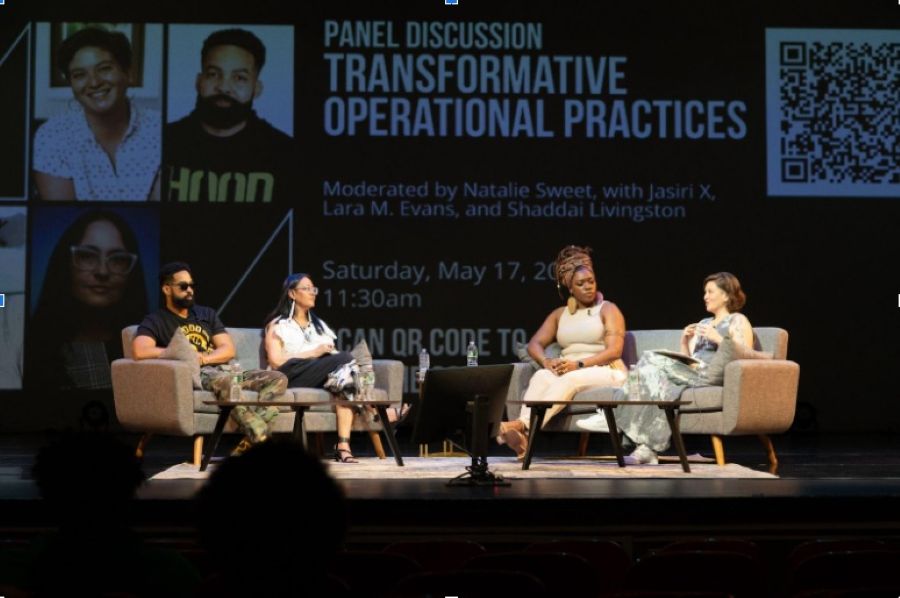
AMERICAN THEATRE: In May 2025, Kelly Strayhorn Theater (KST) presented “Owning Our Future: A Symposium on BIPOC Institutional Ownership,” bringing together visionary leaders from across the country in art, activism, urban planning, philanthropy, and government to envision a future for BIPOC-led cultural spaces. We built the symposium around a few central questions: What does it mean to own a BIPOC institution financially, operationally, and physically? And how can we think beyond brick-and-mortar spaces to the point where our communities own their culture, ideas, and bodies? In other words, what does cultural ownership mean to us?


2 comments:
What I admire more about the sentiments reflected in this article and behind the Symposium is that it focuses on reimagining as a central tenet behind the larger project of supporting BIPOC Institutions and their leadership, not due to disfunction, but instead as a means of overcoming the barriers that are placed in front of them at every corner and as a means of pushing forward their goals to better support and grow into their surrounding communities. When we focus on optimizing instead of reimagining, we lead ourselves into a space where there is a ceiling, as opposed to room to continue to grow and benefit others through the work we’re able to do. Opening our eyes to how we can change our institutions to have a greater impact on others and improving our surrounding community with the changes we make internally is the first step in this process, then followed by the education and collective conversations also discussed in the article. By expanding our mindset and providing the educational tools for this work is wonderful to hear and am only wishing the best for those involved in the symposium.
I thought that this was a really interesting read. I've always tended to see a reimagining or restructuring organization as a sign of tension in some capacity, whether it be more related towards the people, or a sign of emotional distress, or just simply times changing. It was interesting to read this article from the perspective of change being something that requires change on your end. by that, I mean that what this article seems to be focusing on is the idea that although everything in their community, with their program is still running smoothly, that doesn't mean that they can't be looking ahead, and imagining where they can take this theater in a new direction, that helps further support their community and the people around them.I'm really glad that they decided to focus on community as much as they did in this article, especially the parts about there being so much greater community outreach that's really uplifting the area around them. I think that's often something said by a lot of theater organizations, but it's not always followed through.
Post a Comment