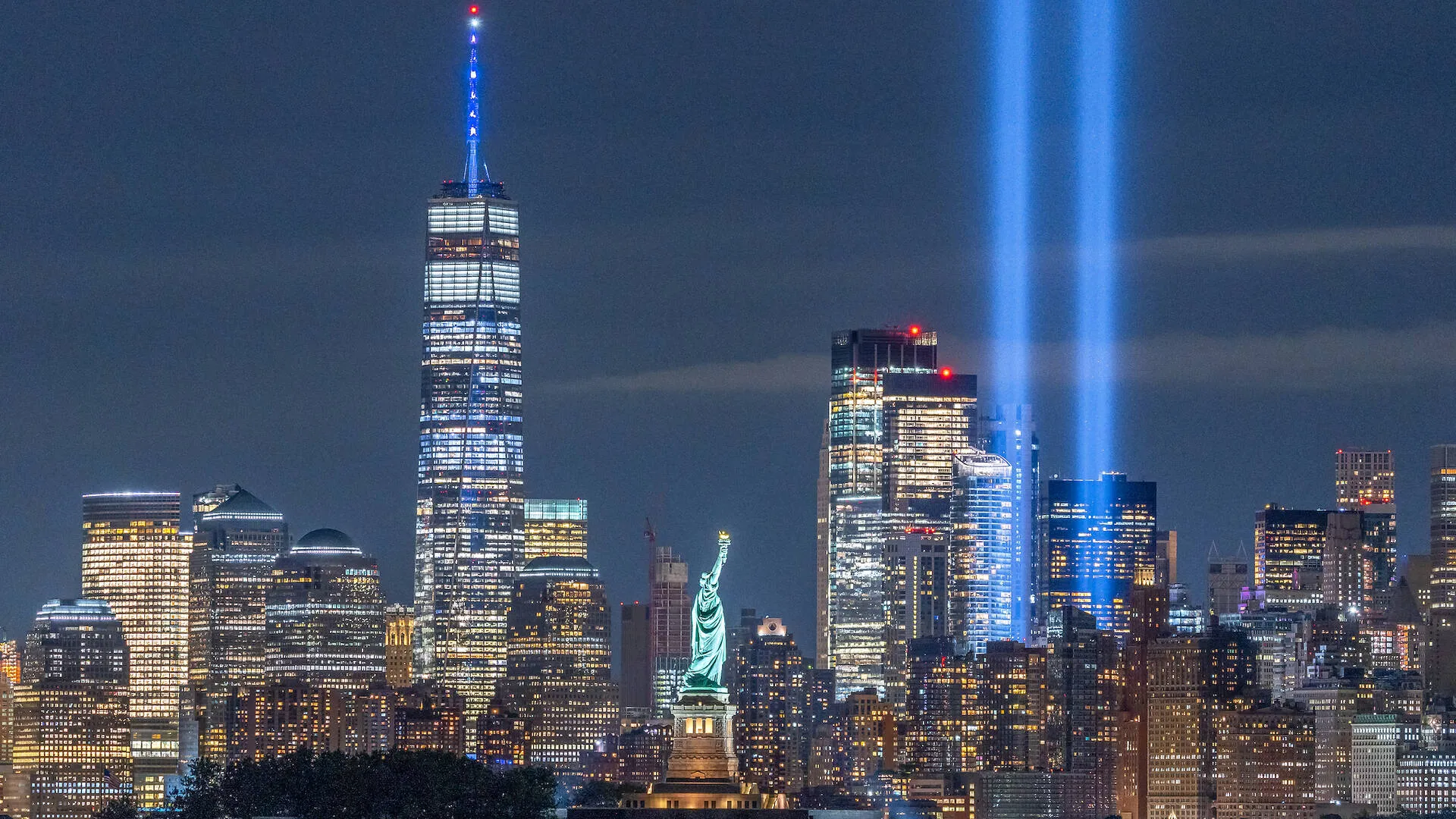
www.timeout.com/newyork: Every September 11 since 2003, two colossal pillars of blue light have illuminated the night sky, filling the gap in the skyline where the Twin Towers once stood. This art installation called Tribute in Light will once again beam into the clouds this September 11, marking 24 years since the terrorist attacks that killed 2,977 people in New York City and changed the world as we know it.


10 comments:
I thought this article was super interesting. Four things that I found particularly interesting were the actual location of the lights, what was used to create the light beams, how the piece was created by a whole team of artists and how about 100 million Americans weren't alive during 9/11. The article mentions how rather than being at the exact locations where the towers fell, the lights are positioned on the roof of a nearby garage. This makes sense because there are two reflecting pools where the towers used to stand as part of the memorial. I also thought it was cool to learn that although it arrears to be two singular beams of light, it is actually 88 7,000-watt xenon lightbulbs that are positioned to appear to be singular beams of light. I also think having the memorial designed by a team of artists made it super successful because it brought different interpretations to the design process.
I did not know that it was lit from a nearby building and not from the Twin Towers itself. That makes sense though after seeing the image of the lights that create the beams it makes sense how that wouldn’t work with 9/11 Memorial pools. I always wonder how they test installations this large but I guess the only way is to make it light up before the real day. I also didn’t think the number was as large as 100 million for Americans born post 9/11. I think it is neat that the electricity company that helped restore power after the attack is behind the memorial installation. While many anniversaries for tragedies involve visual remembrance ceremonies/traditions, I feel like this is one of the largest in terms of visibility and unique in that there is nothing else like it in the US that I’m aware of.
Tribute In Light is one of the most important art installations of the 21st century. This idea is extremely clever and in my opinion pays great homage to the 9/11 tragedies. I found it really interesting that it takes the entire roof of a parking garage to emit enough light to make the towers. It took 88 7,000 watt bulbs to create this installation, which is mind boggling. I want to know more about how they draw such a large amount of power from the roof of a parking garage. I think that it is so cool that the entirety of New York City can see these beams, with its 60 mile viewing radius, as these events affected everyone in the city in some way. I would also really like to know how much it costs to run these beams all the way from dusk to dawn? I believe that the most important part of art is the impact that it makes. The fact that this art installation provides so much “light” and “sunshine” to the people of New York is amazing!
Since elementary school I have always been interested in the history and untold stories of 9/11 which is a weird thing to be fascinated in so young but it was always so scary and heartbreaking to me to see, especially because both of my parents were in New York City when it happened, even though they were safe. This article was so interesting to me, seeing how the artist decided to design the memorial is really interesting, #5 on this list in the article was my favorite one. I have seen clips of the lights from planes and it's so cool. I hope the artists are proud of their work because I think it is a beautiful memorial that honors all the victims of 9/11. I haven’t seen the light live but I have seen the memorial and it's so beautiful. The attention to details all the way down to adding the roses to all the victims names on their birthdays makes me feel so many emotions so strongly. I hope all of the victims' families are doing ok, may all of the victims rest in peace.
Its really interesting to see the non-obvious places in which things we use in theater pop up, even if they're slightly different uses like the lights in this memorial. I've visited the 9/11 memorial in new york, and the places where the towers actually were is a very beautiful spot honoring those who lost their lives. It was interesting to me though that the beams aren't actually projected from there, and instead a nearby roof, which makes a lot of logistical sense. I'd be curious though to know how much electricity it takes to create such powerful lights like that. I also wonder how far up you would be able to see the light, like if you were in a plane flying over could you see the lights below, or depending on how close you are to the ground, could you fly past them? I also find it really cool that each individual beam of light comes from a different bulb, and that they each turn on one at a time until eventually all of them are on together to create such a unified and bright effect.
How do you remind people that something that should be there isn’t. That something once stood in that blank space and the fact it no longer stands is significant. Especially when the majority of people alive today never even saw the towers before they fell. Theatre is about telling stories. Often these stories involve dialogue and actors. But sometimes the visuals can speak for themselves. Light is ephemeral, you can see its beams but it isn’t really physically there. That’s what makes it perfect for this memorial. For one night two great towers of light soar into the sky for all to see. The next it’s gone. Just as the world trade center was destroyed without any word of warning there is no fanfare for the beams of light disappearing. This memorial tells a story without words. Even those who weren’t alive to see the world trade center have heard about the attack. But as the visual idea of what happened on that tragic day slowly fades in the minds of the public this memorial serves as a yearly reminder. There one day. Gone the next.
This was a pretty interesting article. I didn’t know about the Tribute in Light at all before reading this, so it’s cool to learn more about it. I think it’s a good way to remember the tragedy and honor all of those who lost their lives in it. Visually, it looks absolutely amazing. The shear size of it and that it can be seen for miles makes it incredibly powerful. It’s crazy that the tradition started in 2003, but even in 2002 they had lights set up. It’s really been going on for every year since 2001. I was surprised to hear that the lights aren’t actually set up on the site where the towers stood, and I wonder if the parking garage is close enough to the site that a person wouldn’t be able to tell the difference from a distance. By my math, the entire setup uses more electricity in 12 hours than an average home would use in 12 months, which is a crazy amount of energy.
It's kind of interesting how they use the convergence of the lights as the memorial gets higher. It does, unfortunately, show my big fault with this article, and it's that it really doesn’t go in depth at all with any of the facts it gives. When it talks about the memorial being designed by artists and that it was difficult getting light to go that high in a visible way, I wish it had talked about what the artists did to fix that or maybe what the initial design looked like. I can guess from the photos provided that the solution was in the convergence of the lights as they get higher to help with the distance decay. It is really impressive that they were able to have the memorial up so quickly, especially since it went up during active clean-up measures. It feels very weird how overshadowed this all got this year.
As a theatre student studying sound design, I’m deeply moved by the Tribute in Light installation and its enduring power as both an artwork and a memorial. The use of 88 xenon bulbs to form two towering beams of light is a perfect example of how technical artistry can carry profound emotional weight. It reminds me of how, in theatre, lighting and sound are often the most abstract design elements, yet they are capable of evoking memory, atmosphere, and grief in ways that words and visuals cannot always capture. Knowing that the beams can be seen from 60 miles away underscores the installation’s role as a shared communal experience, uniting people across the region in reflection. For my generation—many of whom weren’t alive during 9/11—artworks like this bridge the gap between lived history and collective remembrance. It’s a testament to how design and technology can become sacred storytelling tools.
This was a really interesting article to read. I’ve seen photos and videos of this installation every year, but I’ve never learned much about it. Definitely, the most shocking thing I learned from this article was the fact that the lights are not placed at the location of the Twin Towers, but instead at a nearby parking garage. It’s really interesting how the perspective of the light still makes it look like it is right where the Twin Towers were. I never would have thought that it wasn’t at the actual location, based on every photo I have seen of the installation. Similarly, I wouldn’t have expected the light to be made up of that many smaller lights. This entire installation, on top of being a really well-crafted memorial, is also a really excellent example of how what we see from a light is often very different from what the light actually is.
Post a Comment