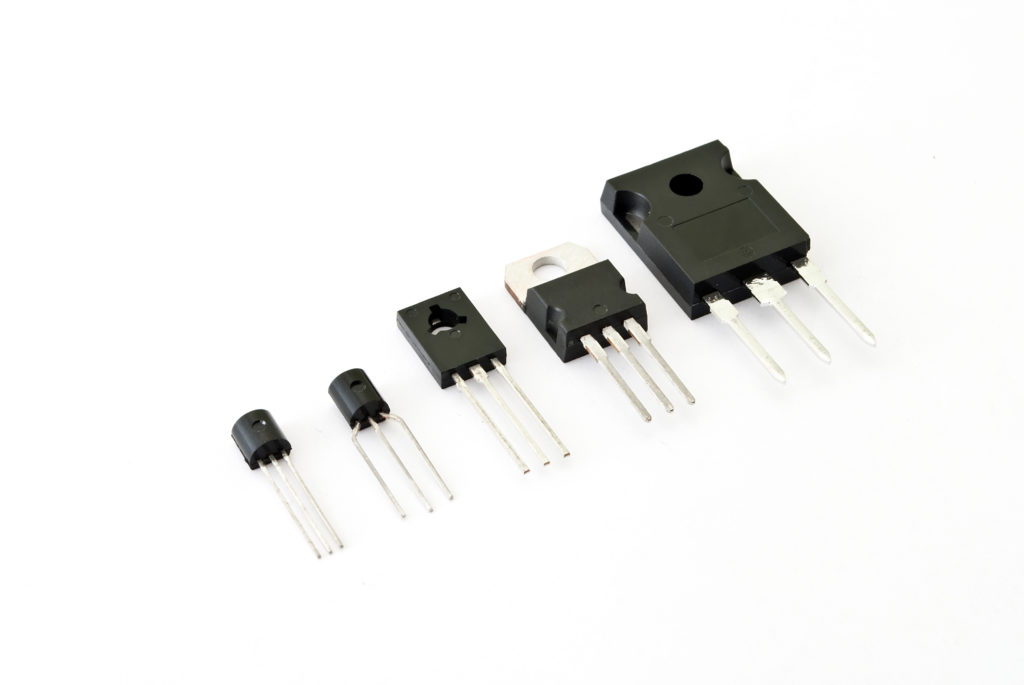
Fusion 360 Blog: Transistors are one of the most commonly used elements in electronic circuits. Their ease of use and simple working principle is what makes them popular among electronic designers. They mainly perform two functions: switching and amplification. You just need a few calculations to introduce this three-legged device into your next project and enable it to function correctly.


3 comments:
This is one of the few times I've seen an introduction to transistors that covers all the bases while attempting to reach a novice audience. Transistors are a massively complicated and innovative electrical component, and one could go on for weeks about how they work and when to use them. In reality, though, unless you're into designing crazy complex and highly engineered electronics, we don't really need to know all that. Nevertheless, the article goes over most of the basic forms without having to go into the math. While this can simplify our understanding, I think it moves way too quickly assuming the reader already has a firm grasp on RC circuits and signal processing. Furthermore, 90% of the time I have used transistors was as a switch, which is far simpler to grasp and in my opinion more important to discuss. Here, the discussion only takes place after going through three much more complex examples, which could overwhelm and turn away readers. Personally, I would keep the material science information (maybe a bit more watered down), and stick only to using them as switches. After that, another follow-up article could go into more detail about using various configurations to process signals.
I. Love. Transistors. If we didn’t have transistors, we couldn’t amplify any signal, and so we couldn’t even have sound! There would be nothing to resist or impede or equalize. I knew a bit about transistors before reading this article, but this really cemented my knowledge about them. They provide switching and amplification and are made out of semiconductor material (so they have p-type and n-type regions.) The current flows from the base (positive region) to the emitter (the n-type region). When the base voltage is high enough, and the collector is at a higher "positive potential,” the current will flow towards the collector. I agree with Elliot that examples get complex fast. I got lost when they started talking about how the emitter is “common” to both the input and output.
When the article started to talk about capacitors, I knew I was back in it. I love capacitors even more than I love transistors, because of how condenser microphones rely on capacitors. It was interesting to learn about how transistors and capacitors are used in oscillators, because I know that oscillators generate clock signals for electronic systems, but I never understood how.
I was introduced to transistors the first semester in my Electrical Engineering class, and they’ve proven to be very useful little devices! As the article says, a transistor is made out of “semiconductor material,” which means the material is between a conductor and insulator (in reference to its conductance of electricity). This divides an N type region and a P type region (which refers to charge). The device switches between the two, using a small amount of input current (from outside the device) to create a larger current.
In my engineering class, we use a lot of MOSFETS (Metal Oxide Semiconductor Field Effect Transistors) in things like operational amplifiers and logic gates. They are very useful, and I’m glad the theatre audience is learning about them! They’re definitely a niche subject for the average technician, but can help introduce someone to engineering, which is used behind the scenes in theatre.
I just realized, as I was about to post this, I wrote a comment on this article in the first semester and completely forgot. I’ll post this one anyways (it is kind of interesting to see now how much more I know about transistors.)
Post a Comment