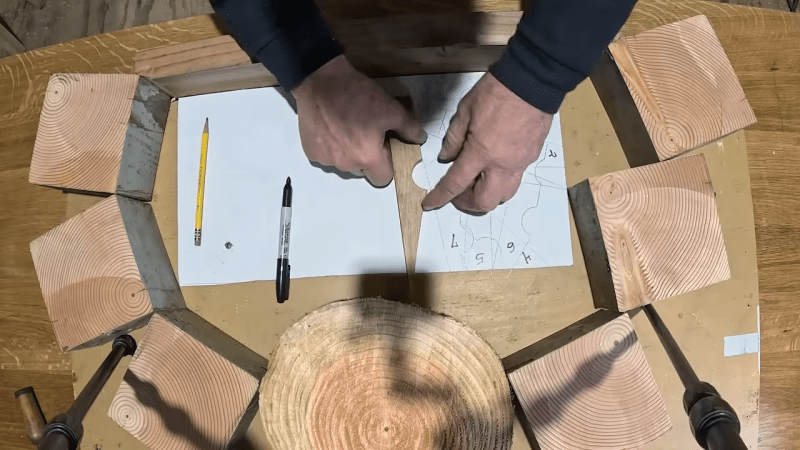
Hackaday: Picture this: you have an irregular opening you need to fabricate a piece to fill. Maybe it’s the stonework of a fireplace; maybe it’s the curved bulkhead of a ship. How do you get that shape? The most “Hackaday” answer would be to 3D scan the area, create a CAD model based on the point cloud, and route the shape with CNC.


2 comments:
I have not used a tick stick before, but I found this article to be interesting. The idea is pretty simple geometrically speaking, but it's very smart. I encountered a similar problem while building a window seat in my kitchen with my dad a few years ago. The idea I came up with (and that we used) was to get a large, heavy duty piece of paper that covered the entire irregular octagon of space, and cut/mark it up. This was effective overall. I think that we could have gotten it to be a little bit more precise, but it did work. And now we have a window seat which is fun. But the tick stick is a good idea and would have worked really well in that scenario. The craftsman interviewed for this article reported that this is only a problem he's encountered a select few amount of times over many decades. It is a rare problem, but one that needs a unique solution when encountered, and I'm glad I'm aware of this now.
This is a really cool tactic for abnormal shapes. To put down a thin material and fasten it within the space, point to vertices with the tick stick and mark it on the material, and to repeat that around the shape; then to transfer that template onto a final material. It doesn’t seem to be foolproof with radial shapes or with the more loose/sloppy corners, but it's a great tool for relatively consistent production of a one-time object. The video attached to the article was really useful to visualize the process, and makes a lot of sense. This does seem slightly time consuming, but good in a pinch if one doesn’t have more modern technology or tools. Even in the video, the product was a touch rough, but given that the applications are limited, I’d imagine there are few instances where the tolerance would matter so much that one can’t have a transitional piece to help.
Post a Comment