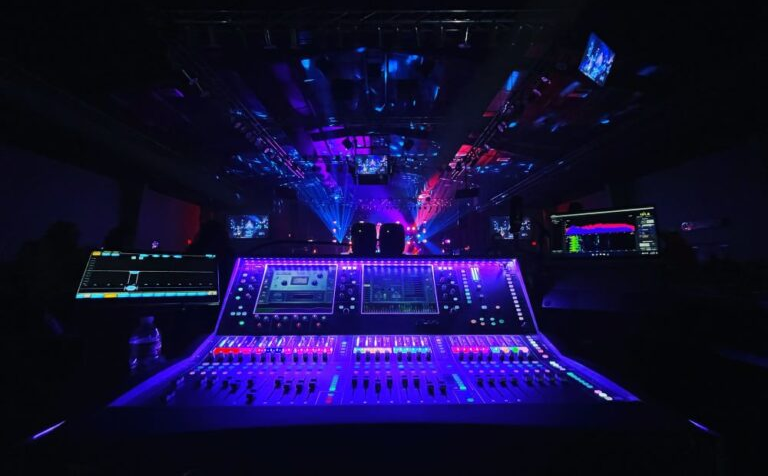
ProSoundWeb: When we talk of “large frame” consoles, older analog units with channel counts of 40 inputs or more come to mind because they actually had very large frames loaded with channel strips. In today’s digital world, however, we’re usually referring to a console that can professionally handle a large production, even if physically it’s not all that sizeable, because most use layers of fader banks to access additional channels and functions like aux sends on faders.


1 comment:
Large-Format Digital Consoles are not as intimidating as they seem. I feel like once you understand how an analog sound console works, the digital is a lot easier to navigate because the principles of sound design are still the same. I used a Yamaha QL5 console all throughout high school to mix all of our shows and at first I was super intimidated with all the different hidden layers and the layout of the board but by the time I got to senior year, everything made sense and I knew the layout of the board like the back of my hand. I feel like the one thing about digital consoles is the fact that none of them are the same and it all depends on the manufacturer of the board because every company has their own way of laying out a board but once you understand in general how a board works and all the signal flows, you should be able to navigate any board and also looking at the manual is always helpful.
Post a Comment