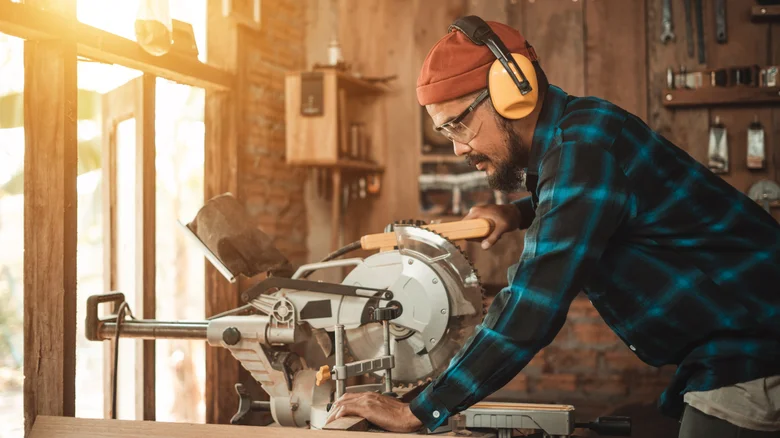
www.slashgear.com: The journey of the prototypical hobbyist woodworker is a fascinating one. Many people get into this adventure because they want to make a piece of furniture for their home. There's also a range of woodworkers who make the jump from carpentry. You may have built cabinets for your kitchen and then thought about other ways you could save money by crafting more pieces on your own.


6 comments:
I have done a lot of woodworking over the years for theatre. I would say that I have gotten pretty good at remembering to wear PPE and safety guidelines, but it wasn’t always that way. When first starting, I didn’t rly get the reasoning for PPE because I was young and overconfident in my skills. However as I gained more experience, and heard more stories about what happens when you don’t wear PPE, I realized that it’s not about how skilled you are, its about the fact that a machine does not know or care about the difference between wood and your arm or face. Reading about this article and the safety tools makes me realize how many things we have now to make our jobs easier and safer. I had not heard of some of the tools such as bench dogs and others I have like respirators and dust collectors. I think is great that people are putting just as much attention and quality into safety tools as working ones. This means that woodworking will continue to get easier and safer for everyone, something that makes all our lives better.
I was curious to see what sorts of PPE this article would suggest beyond the usual. Overall I think these all seem like pretty good suggestions. Throughout my life I have experienced many different opinions on if regular glasses count as safety glasses. Personally I think regular glasses should be considered sufficient for common applications like using a hand drill or miter saw, but around a staple gun, nailgun, or something that throws off sparks I would probably prefer to use safety goggles that can fit over my glasses. I appreciated that the article brought up the chisel sharpening jig as component of safety gear, though the reason I would give isn’t directly discussed (dull tools are themselves dangerous because they require more force than you would otherwise use, which means you have less control and are therefore more likely to slip up and hurt yourself). This is why keeping your tools sharp, though counterintuitive, is a key part of safety.
I have done shop in a lot of different places, all of which have their own safety procedures, and different budgets of safety gear. These are honestly not all what I was expecting to see. I was expecting the classic, glasses, gloves, shoes, etc. A lot of these are materials that I would use at the higher end shops I’ve worked at because they can afford nicer materials that do a nicer job. For instance, the pocket hole jig. I was taught to use one of these when toe nailing wood. Then I moved and no one knew what I was talking about. Not only does it make your life easier, and your wood look nicer, but it is objectively safer. I think a lot of shops forgo these because they are under the same impression that I was, that these just make your project look nicer, but in reality they are also much safer.
I personally am a huge fan of the shop apron. As long as its durable and has lots of pockets, I would get one possibly. It reminds me of the overalls I have for crew calls. I like having lots of pockets and places to store goodies. I also think the push stick is interesting - what is the difference between a push stick and a push block? Why is the Carnegie Mellon University School of Drama's scene shop's push stick wooden instead of either plastic or another material? I wonder if one is safer than the other. I would imagine that both would be sliced if they touched the blade. Would the wood be safer because it would be cleanly cut, or the plastic? Would the plastic hurt the blade? How many revolutions/much speed on the blade do you need to cut plastic? This is interesting for anyone to know about scenery safety.
As someone who is constantly in shops doing work, I know deeply the value of PPE. It is absolutely necessary when doing carpentry, no matter how skilled you are. Several times I have been using a circular saw, or will even just be making a cut with a mitre saw, and will feel a wood chip bounce off my safety glasses. At my old job, there were 3 different Technical Directors over the course of about a year. While the current one is great, the second one would often not wear safety glasses when working with tools. While perhaps unrelated, it may be worth noting that he had a glass eye. He was later fired for not following safety guidelines. I appreciate how this article also addresses other factors for additional safety in the shop, like a dust separator. I feel that one of the most overlooked safety factors in a shop is cleanliness. Sawdust is very slippery and not cleaning it up can lead to falls and other shop accidents.
Safety is obviously super important in a shop environment, and this was a pretty standard article going over a lot of pretty standard things regarding shop safety. I thought that this article had a really good lineup of safety devices including. It covered all of the bases, from classic eye and ear protection and respirators, to stuff to keep your hands from slipping, to some stuff that I feel like doesn’t get emphasized in the safety world a ton, like dust separators. I think that my favorite safety device from the list is probably the pocket hole jig. I’m a big fan of those little jigs. They’re such a compact device, and they improve the stability and quality of the work so much when drilling inconvenient holes. Like the article said, any sort of “pocket hole” is sometimes given a hard time from Real Woodworkers, but sometimes it is just useful.
Post a Comment