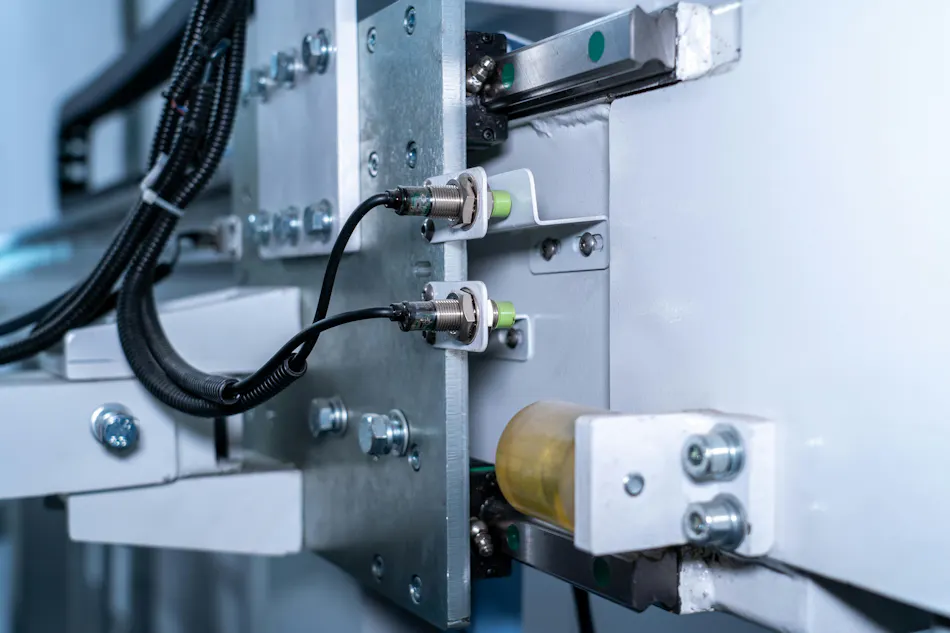
Control Design: My first exposure to proximity switches was after college as a design-and-build engineer at a fiber optics plant. The switches were end-of-travel and home switches on linear slides of a production machine. I then noticed that they were being used for door-lock indication, speed detection of flywheels and gears and many other use cases throughout the different manufacturing lines.


4 comments:
When I saw the title, this article piqued my interest because I do not know much about non contact presence sensing. The article starts by talking about how the sensors are used in industry as a means of detection, industry and in like a plant. One way that I would be interested in seeing it applied in the world of theatre is automated lighting cues. I am imagining an emotional musical number from an actor that has a lot of movement choreography as opposed to dancing; like dramatically running to different parts of the set. Once they reach a specific point, there would be a sensor onstage to detect their presence, and the lights could change to reflect that. While the effect definitely seems very cool, I am not positive if the effort is worth it. Assuming the stage manager does not have too many other cues to call, having the sensors trigger the next cue would only increase the precision marginally.
This is a very intriguing article, and I can' help but think about the Automation Wagons for 'Company' when looking at what these sensors do. The main question I have in the use of these sensors for company though is weather or not these sensors can communicate data to navigator that can be used to create a stop in the system. Next I am not sure as to how adjustable these sensors are and weather or not you can adjust the range at which these sensors would be sending a stop signal back to navigator when they are attached to the wagons. Out of the three sensors showcased in this article the Capacitive Proximity Sensor, and the Passive Infrared Sensors. The first would be good for detecting objects in the wagons path that can then either tell the wagons to slow down or stop if there is something within the electrostatic field. On the other hand the infrared sensor would be good for detecting people in the wagons path, and could function the same way as the previous sensor.
I have worked a lot with mechanical sensors like limit switches and using software along with feedback from motors. I don’t have a lot of personal experience with proximity sensors, but I do know that there are some cameras that work well with vision software to make sense of position data. I have worked with robots a lot and these types of proximity sensors are used sparingly when needed because in practice mechanical limit switches can be easier to work into software. I had never heard of inductive proximity sensors before this article, but they seem really interesting. I bet that there are some scenarios where these types of sensors aren’t practical, but they seem extremely useful. I wonder how large the field of sensing can reach for these types of sensors. One type of sensor that I have seen in use is cameras used in conjunction with simplified qr codes, known as April tags.
This is such an interesting example of the technical breakdown of various types of sensors, including their functional characteristics. In the process of working on automation, whether it’s by moving scenic items along tracks or by having safety stop devices for overhead rigging, our understanding of why the sensors exist, how they are built and how they will interact with ambient conditions is very important. The main differentiation between inductive and capacitive sensors will become even more obvious once the subject is addressed from the standpoint of heavy structure (steel) versus more generic materials (scenic).
Inductive sensors are the best available technology for tracking heavy steel or metal scenic wagons and will withstand the build-up of debris. On the other hand, one point that will change the way an individual manages things such as atmospheric props or liquid levels, such as stage blood, while avoiding the build-up of debris on the sensor, is the fact that a capacitive sensor can detect virtually everything.
Post a Comment