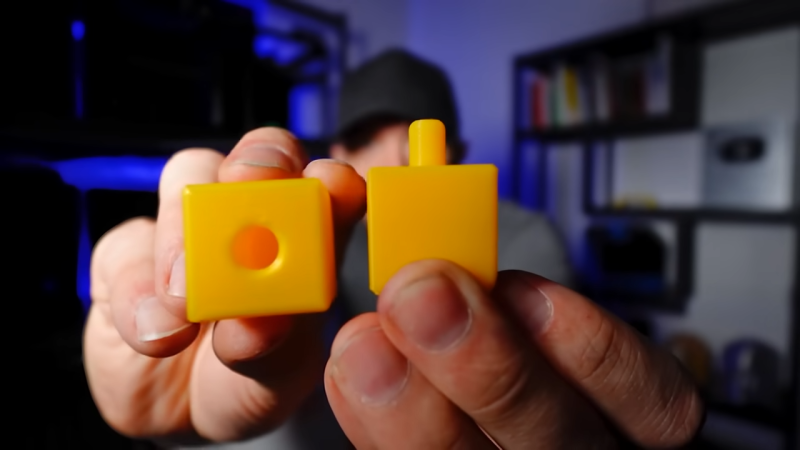
Hackaday: Sure, one can make pins stronger simply by upping infill density or increasing the number of perimeters, but those depend on having access to the slicer settings. If someone else is printing a part, that part’s designer has no actual control over these things. So how can one ensure sturdier pins without relying on specific print settings? [Slant 3D] covers two approaches.


4 comments:
What I enjoy about this article is that it not only demonstrates helpful features for 3 D printing capabilities and increasing your ability to make sturdier parts, but it also shows that when we equip ourselves with more powerful tools with better capabilities at doing complex tasks, we gain new features that are as easy in some ways as the prior version (from the perspective of the printer and its run time per part) that otherwise would not have been possible or effective for us to have done in the first place. What I mean by this is that the article suggests a gear layout for the pin for the 3 D printing which is highly effective here as it occupies roughly the same volume and time while creating a much better and stronger part, but would not be very efficient or easy to do if hand making a similar part. As such, when we use more complex tools, we should look to go against our typical inclinations and see if there are more creative ways to achieve our tasks in a better way given the capabilities of these technologies.
As 3D printers become more accessible and we start utilizing them in our fabrication process it is imperative to understand how to design things so they work the way we intend them to. This article was very informative on how to better utilize the design of the pin to produce a stronger part. This was all before opening the 3D printer software and telling it how dense you want your part or what particular filament you are utilizing for this part. I think as we learn more about 3D printing we will find that we can utilize it in more ways than currently being utilized. Just as we have studied the ways to improve metal fabrication from rivets to welds, I imagine that we will start to discover some standard practices in order to ensure that the part you are printing comes out a success. Because the real cost of 3D printing is time and having to wait another 24-48 hours for your part to finish printing can be at huge cost to the project.
For all the two good suggestions that the article provides, they do not really talk about how to make pins unbreakable. The two suggestions they give can strengthen them significantly but there are no ratios, sizes, or parameters they suggest to keep pins from breaking. The general ideas are there but not follow through. Being able to engineer stronger parts quickly and efficiently and maintaining a quick manufacturing process instead of having to make thousands of dollars in dies for a product that is non functional is incredible and saves incredible amounts of money. I have not seen any super comprehensive source for designing 3d printed joints that covers everything that can help with these problems. There are a lot of good resources out there but I think the space and innovation is going to fast for good, free, and available resources to be published widely and be effective for long
This article explains good practices in 3D printing pins to prevent breaking other than increasing infill density or surface area (or otherwise depending on specific print settings). The first approach delineates making a short, thicker pin and adding a fillet to the corner where the pin meets the part, which, to me, feels very intuitive. Generally, the article talks about microfeatures which use the way the 3D printer works as a way to increase strength. I haven’t really thought about ‘microfeatures’ before, but I’m not super familiar with the concept. For example, small slots going from the edge of the pin into the piece makes it sturdier. Additionally, to make the pin gear-like in using a bunch of little cut outs gives it more surface area per layer, making the pin stronger. I’m a little disappointed in this article’s lack of further recommendations about making 3D printed pins more durable. The internet has a plethora of recommendations, though few from credible resources.
Post a Comment