mymodernmet.com: With the arrival of fall, comes the start of the harvest season. In Niigata prefecture, in Northern Japan, this means rice is ready to be picked—and the rice straw, known as wara, is set to be discarded. Some farmers feed it to animals, while others use it as fertilizer. But after a particular surplus of wara in the mid-aughts, they came up with a creative alternative.
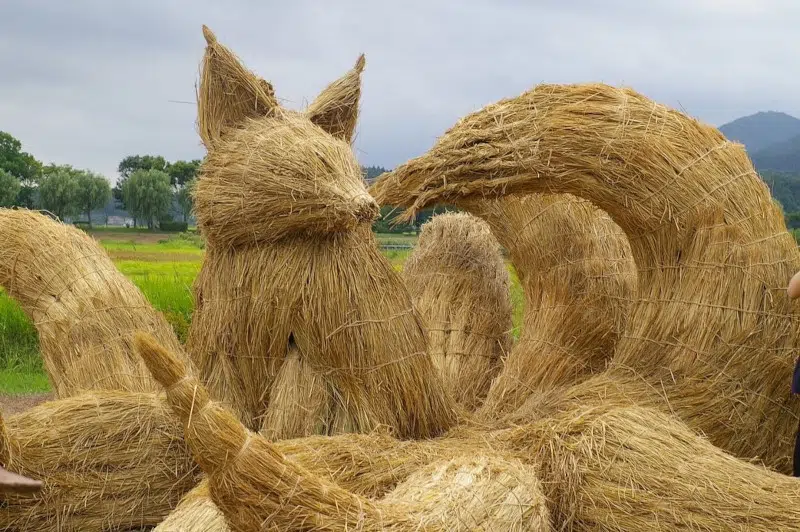
Not only are these sculptures so beautiful and detailed, the fact that they are made by college students is inspiring. The talent these students have is mind boggling, especially now that they are around the same age as me. I also find it super cool that they are creating these sculptures out of the rice straw that would otherwise have no use. I wonder how hard straw is to work with, because just thinking of sitting on the straw bails on tractors hurts my hands. This reminds me of when I made metal wire sculptures. I would constantly find little bits of metal all over my clothes and it would poke my hands every time I tried to bend it. It is a testament to these artists’ abilities that they can wrangle these large bundles of rice straw into recognizable creatures. The eyes especially impress me, because they look so smooth and detailed.
ReplyDeleteTo begin, these sculptures are absolutely beautiful and such a creative and unique way to utilize these materials. After dwelling on it for more time, I wonder what the underlying construction of this is and how much goes into the form of each piece itself, as there is a high level of detail achieved for every piece and from the photos it just appears to be some kind of twine and the straw as the outer layer. Regardless, those that make these sculptures are highly dedicated and definitely skilled to be able to pull off this work and the theme for this year of the festival allows for a great capturing of that with the variable geometry and form for all the various animals sculpted. I hope to see more of this work to come in the future with future festivals and new themes as well, and will look moreso into how these are made from the ground up to better understand and appreciate this work.
ReplyDeleteI just recently went to the Cleveland Museum of Art and I enjoyed it a lot more than I thought I would have. I’ve never really been a museum kind of person but I realized I enjoyed looking at art in person. If I could be able to see these types of sculptures in person I’m sure they would look far better than they already do on the screen. The fact that these are also created by students is amazing. These sculptures look like they were created by experienced professionals who have been creating art for decades. It’s really great to see what younger people can create and it’s kind of inspiring. It makes me wonder, have these students created sculptures like this before or was this their first time ever? And if it was, I wonder how difficult it was to create extraordinary sculptures like these with no prior experience?
ReplyDeleteThese students are so talented. These sculptures look amazing, and straw is such an unconventional material. I would have loved to hear more about the process of using straw. Based on the pictures, it seems that most of the straw is gathered like that on a thatched roof, and tied together into a bundle. However, some of the accessories or smaller more intricate pieces seem to have been woven or wrapped together.
ReplyDeleteI like that these sculptures have fantastical backstories to them! It was hard to research these specific animals, especially in relation to Niigata. I think that a fish was chosen to embody Niigata as the town is seaside, and the city Oija, within Niigata Province, was the birthplace of the koi fish! A golden turtle is generally auspicious, and symbolizes wealth and longevity. A water dragon, or Mizuchi, is often seen as a master of the water, which is why it could have been chosen. A fox with nine tails is also a magical creature with great power. Finally, Nagao Kagetora ruled Echigo Province (now Niigata.)
It was great to learn more about each of these figures and think about how these structures could have been made.